

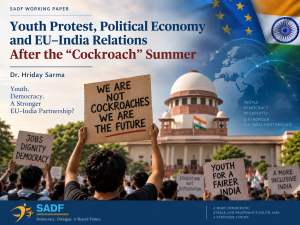
What began as a judge’s insult about “cockroaches” became a youth movement capable of forcing a minister’s resignation, testing India’s democratic institutions, and potentially complicating the EU’s most ambitious new partnership in South Asia.
Abstract
In May 2026, a dismissive remark by India’s Chief Justice comparing unemployed youth to “cockroaches” triggered an unusually fast-moving political phenomenon. Within twenty-four hours, it had a name, the “Cockroach Janta Party” (CJP); within weeks, millions of online followers; and by July, a large-scale street mobilisation of a kind the Modi government had faced since beginning its third term. This Working Paper examines the Cockroach Phenomenon as a case of generational discontent. It tests whether the movement reflects an impulse to renew India’s democratic system rather than reject it, without assuming this interpretation from the outset. The analysis places the movement within two wider contexts: India’s domestic political economy and its relationship with the European Union at a consequential moment.
The central hypothesis finds only mixed support. The movement’s main achieved demand, the education minister’s resignation over examination fraud, was pursued through existing institutional channels. Yet the scale of the police response, hardening Hindu-nationalist rhetoric, and the movement’s organisational fragility, including its public rupture with Nihang Sikh groups (a Sikh religious and warrior order), make any simple reading of institutional renewal difficult. The paper also examines its uneven coalition with farm unions and the Left, opposition parties’ cautious courtship, India’s corporate and regulatory concentration, and civil-liberties trends. In September, the Supreme Court quashed FIRs against students who joined the July protests under Article 142, after which CJP called off its planned September 5 march.
A fatality linked to the movement’s post-protest school-audit campaign, reported in mid-August, has further raised the stakes. With the EU having concluded a landmark Free Trade Agreement with India in January 2026 and still facing a ratification process carrying its own risks and precedents, the paper argues that the EU has both a substantive interest and a legitimate, non-interventionist channel for monitoring these developments as the relationship deepens.
- Background and research question
On 15 May 2026, during a Supreme Court hearing on fake legal credentials and the misuse of senior-advocate designations, Chief Justice of India Surya Kant described unemployed young people who turn to the media, social media, and activism as behaving like “cockroaches” and “parasites” attacking the system (Sharma, 2026a). He clarified the next day that the remark had targeted individuals fraudulently entering the legal profession rather than youth in general (Sharma, 2026a); the clarification did not contain the reaction. Within twenty-four hours, Abhijeet Dipke, a 30-year-old political communications strategist who volunteered with the Aam Aadmi Party (AAP) from 2020 to 2023, launched the Cockroach Janta Party (CJP).[1] At the time, he was pursuing a master’s degree at Boston University and used the new party’s name to reclaim the insult while parodying the ruling Bharatiya Janata Party (BJP) (Kaur, 2026).
The movement is not, at the time of writing, a registered political party; its spokespeople describe it as a “pressure group,” and its Election Commission status remains unregistered (Zee News, 2026; Joseph et al., 2026). In just three days, the Cockroach Janta Party (CJP) had crossed 3.7 million followers on Instagram, while more than 350,000 people had submitted membership forms through a Google Form shared by its founder, Abhijeet Dipke (Sharma, 2026; Mondal, 2026). It also drew two sitting Trinamool Congress (TMC) members of parliament (MPs), Mahua Moitra and Kirti Azad, into public association with it (Zee News, 2026; Sharma, 2026a). Within six weeks, satire had acquired a physical protest camp at Jantar Mantar, a hunger strike by activist Sonam Wangchuk, a formal alliance with India’s largest farm-union umbrella body, a violent confrontation with Delhi Police injuring roughly 180 people, and the resignation of a Union Cabinet minister (Saaliq & Ganguly, 2026; Hadid & Khandekar, 2026).
This Working Paper treats the “Cockroach phenomenon” as analytically distinct from India’s formal party system: a digitally native protest movement working adjacent to, rather than inside, electoral politics. Non-Indian readers should note that Jantar Mantar — a designated protest ground near India’s Parliament — has hosted many unrelated demonstrations over the past two decades; this paper concerns only events connected to CJP between May and August 2026.
The central research question this paper addresses is: to what extent does India’s Cockroach phenomenon represent a generational challenge to entrenched political and economic structures, and what could its consequences be for India’s domestic political economy and its international partners, particularly the European Union? It tests, against the evidence, the hypothesis that the movement reflects an attempt to renew rather than reject India’s institutional order.
Analysis and arguments
2.1 From slur to swarm: anatomy of a movement
CJP’s rapid growth was enabled by, and provoked, direct confrontation with the state’s digital toolkit. The government withheld the movement’s original X account in its first week, citing threats to national security; Dipke opened a new one under the slogan “cockroaches don’t die,” and Instagram followers kept growing even after reports the account had been targeted by hackers (Khandekar & Kuchay, 2026). Union ministers Kiren Rijiju and Sukanta Majumdar separately suggested its support base was substantially foreign or Pakistani in origin; Dipke published follower-location data showing a 94 per cent Indian audience, corroborated by independent estimates and India’s Ministry of External Affairs (Khandekar & Kuchay, 2026).
The movement’s public platform has been described somewhat differently across its own and unofficial online sources, reflecting its leaderless, meme-driven structure and the absence of a fixed secretariat. The proposals that appear most consistently include barring retired Chief Justices from post-retirement Rajya Sabha nominations; holding the Chief Election Commissioner accountable for erroneous deletions from electoral rolls; increasing women’s representation in Parliament and the Cabinet; imposing a twenty-year disqualification on legislators who defect; and, in some versions but not others, revoking broadcast licences linked to the Adani and Ambani conglomerates. None is a tabled bill; CJP describes them as a public-pressure agenda rather than enactable policy. The satire was never purely rhetorical: volunteers ran street clean-up drives dressed in cockroach costumes, a self-mocking visual joke that, amplified by participants recording and sharing the events on social media (India Today, 2026; CJP, 2026b), did as much to spread the brand on video platforms as any manifesto line. Separately, a Cockroach Students’ Union of India (CSUI) emerged within days as a student wing of the CJP, organising on campuses across the country (CJP, 2026a).
CJP’s Instagram following kept climbing after the sit-in ended, reaching roughly 24–25 million by mid-August, still more than twice the BJP’s own account (Warsi, 2026; Mukherjee, 2026). The movement did not disband once Pradhan resigned: on 15 August it launched “School Thik Karo” (“Fix the School”), asking supporters to film and publicise poor conditions in local government schools, the subject of Section 2.8.
2.2 Testing the hypothesis: renewal, rejection, or something else?
The proposition that CJP reflects pressure to renew rather than reject India’s system finds real support in the movement’s own conduct. Its one fully realised demand — the resignation of Education Minister Dharmendra Pradhan over the 2026 NEET-UG paper leak and CBSE marking irregularities — was pursued through recognisable constitutional means: protest, media pressure and ministerial accountability, not a challenge to the constitutional order itself (Sharma, 2026b; Encyclopaedia Britannica, 2026). The government’s own written assurances — reviewing cases against non-violent protesters, discussing fixes to examination security, and a pledged ₹1 crore (roughly US$135,000) compensation for the families of NEET aspirants who died amid the exam crisis (Wikipedia, 2026b) — indicate negotiation rather than pure confrontation.
Three complications qualify this reading:
- First, the scale of the state’s response, including tear gas, batons and pellet guns used on 20–21 July that injured approximately 180 people, detentions across Delhi, Assam, West Bengal and Bihar (Agence France-Presse, 2026), and the forced hospitalisation of hunger-striker Sonam Wangchuk on 18 July, when “the government appeared to panic” over his declining health (Dhume, 2026), suggests that the authorities were not comfortably absorbing dissent. Amnesty International’s India chair, Aakar Patel, said that events at Jantar Mantar showed that “peaceful dissent is being suppressed,” while metro services and mobile internet were suspended to restrict assembly (Amnesty International, 2026). A 20-year-old protester, Sona Bisht, similarly told reporters that the crackdown had strengthened her resolve to remain “till the time our demands are not met” (Saaliq & Ganguly, 2026).
- Second, ruling-coalition voices shifted from initial tolerance to sharper delegitimization. In June, RSS spokesperson Sunil Ambedkar said there should be “space for different opinions” (Menon, 2026). By July, however, RSS joint general secretary Atul Limaye described the protests as anti-constitutional and anti-national, while alleging that the Left had co-opted what began as a spontaneous grievance (Wikipedia, 2026a). The shift suggests that sections of the establishment increasingly viewed the movement as a political threat rather than as a potential partner in renewal.
- Third, the Trotskyist World Socialist Web Site offers a contrasting interpretation, arguing that the CJP operates as a “safety valve” by channeling public anger toward reformist politics rather than confronting the structural causes of youth unemployment (Kumara, 2026). This critique adds an important qualification: the movement can represent a genuine demand for political renewal while still facing criticism from the left for failing to challenge deeper economic structures.
On balance, the evidence supports a qualified version of the hypothesis: CJP’s stated demands are institutional-reform demands, not revolutionary ones, and its one major victory came through constitutional channels. But the intensity of the state’s reaction and the movement’s own organisational fragility — discussed below — mean this should be read as evidence of institutional strain as much as of institutional resilience.
A further test arrived on 20 August, when CJP-backed “Legal Cockroaches” protesters, joined by the All India Young Advocates Association and the Bombay Bar Association, demanded the resignation of Bar Council of India chairman Manan Kumar Mishra over a BCI decision freezing admissions at NALSAR University of Law, Hyderabad (Outlook News Desk, 2026). Mishra — a sitting BJP Rajya Sabha MP who has chaired the BCI unopposed for an unprecedented seven consecutive terms since 2014 — is a ruling-party-aligned figure, not an opposition target, which makes this a genuine test of whether CJP’s accountability logic runs even-handedly or only selectively. The movement turned its long-tenure critique on a BJP-affiliated regulator instead of confining it to opposition or bureaucratic targets, which fits the renewal hypothesis better than a purely anti-BJP reading of the movement would — though whether the ruling party treats the episode as a manageable individual controversy or, as with Pradhan, eventual grounds for personnel change remains unresolved at the time of writing.
2.3 An uneven coalition: farmers, the Left, and the Nihang Sikh fracture
Claims that the movement was simply “joined” by India’s Sikh community require more precision than the public narrative sometimes allows; the evidence here is genuinely mixed. Ahead of CJP’s first major rally on 6 June, a viral video claimed farmers and Nihang Sikh groups (a Sikh religious and warrior order prominent in the 2020–21 farm-law protests)[2] might join a planned sit-in; CJP made no such announcement, and the claim appears to have circulated as rumour rather than confirmed plan (The Sunday Guardian, 2026).
What subsequently materialised diverged along two tracks. Organised agriculture unions engaged formally and durably: the Samyukta Kisan Morcha (SKM), the umbrella body that led the 2020–21 farm-law protests, pledged “wholehearted solidarity” and sent a delegation to Jantar Mantar in early July (NH Digital, 2026); on 16 July, Bharatiya Kisan Union leader Rakesh Tikait joined the sit-in with several hundred farmers, and CJP later reciprocated at an SKM gathering as “a gesture of thanks” (Mishra, 2026). A broad cross-section of Left and civil-society figures — CPI(M)’s M.A. Baby and Brinda Karat, CPI’s D. Raja, activists Prashant Bhushan, Yogendra Yadav, Anjali Bhardwaj and Nikhil Dey, and TMC MP Mahua Moitra — likewise expressed public support (PTI, 2026).
Engagement with Nihang Sikh groups followed a markedly more fraught path. On 23 July, a physical confrontation broke out between CJP protesters and a group of Nihang Sikhs at Jantar Mantar; accounts diverge sharply by source. The RSS-affiliated outlet Organiser reported Nihang Sikhs confronting protesters they described as seeking to “hijack” a students’ movement (Organiser, 2026a); a separate Organiser report said the group had come only in solidarity with students, stating they had “nothing to do with” CJP, and accused Dipke of disrespecting Sikh identity, demanding an apology (Organiser, 2026b). CJP suggested BJP-student-wing infiltrators may have staged the violence to discredit the protest, a claim echoed in disputed social-media corrections to the same footage (Statesman News Service, 2026). No single account can be verified as definitive. What is clear is that, unlike the farm-union alliance, this episode ended in rupture rather than partnership.
The pattern is a coalition of two speeds: durable where CJP engaged secular, organisationally mature actors with a protest-coordination track record (farm unions, established Left formations), and considerably more volatile where its leaderless, meme-driven structure met community or religious identity politics it was not equipped to navigate — a distinction that matters for how broad-based and durable the movement’s base actually is.
What held the coalition together in practice, beyond formal statements of solidarity, were smaller acts of mutual aid that rarely made international headlines. When police baton-charged the 20 July march, Gurdwara Bangla Sahib — one of Delhi’s largest and most prominent Sikh houses of worship, a short walk from Jantar Mantar — opened its doors to shelter injured protesters and stranded commuters (Wikipedia, 2026b), a gesture that sat somewhat uneasily alongside the Nihang confrontation three days later and underlines how heterogeneous the Sikh community’s own relationship with the movement actually was. Coalitions built on this kind of improvised, reciprocal protection have historically proven stickier than those built on shared ideology alone, even when, as here, the ideology itself remains thin.
2.4 Youth unemployment and the economic substrate
The exam-fraud controversy tapped into a deeper economic anxiety, which predates the movement and is unlikely to disappear with it. India’s quarterly Periodic Labour Force Survey recorded unemployment among 15–29 year-olds at 15.9 per cent in April–June 2026, up from 14.6 per cent a year earlier, as labour-force participation eased to 54.6 per cent (The Policy Edge, 2026); urban youth unemployment reportedly reached 18.2 per cent, with young women above 25 per cent (Whalesbook, 2026). Dipke himself has framed the movement in these terms rather than purely constitutional ones: over 65 per cent of India’s population is under 35, he has argued, yet the country’s political leadership and institutions have been slow to reflect that (Mukherjee, 2026) — a framing that is rhetorically rounded but points to a real generational mismatch this paper’s other evidence corroborates. Roughly 30 per cent of India’s population is aged 15 to 29 specifically (Dhume, 2026) — the demographic reservoir the CJI’s remark happened to ignite, and why India’s low headline unemployment rate (3–5 per cent) coexists with acute distress concentrated among educated urban youth, a distinction European analysts should not overlook.
2.5 Opposition parties: courting the swarm without owning it
No major opposition party has moved to absorb CJP outright; the pattern instead illustrates real strategic caution. The Aam Aadmi Party, Dipke’s former political home, engaged earliest, with national convener Arvind Kejriwal visiting Jantar Mantar in mid-July. Congress, by contrast, remained the only major opposition party not to endorse the movement formally; party insiders cited by The Print (Mishra, 2026) worried CJP could become “AAP 2.0” given Dipke’s background, and that Left-backed visibility would blur Congress’s own positioning while it separately invested in Rahul Gandhi’s youth-outreach campaign. Individual figures like Adhir Ranjan Chowdhury voiced personal sympathy, and Shiv Sena (UBT)’s Uddhav Thackeray urged Congress to engage more directly (Mishra, 2026). The Samajwadi Party’s Akhilesh Yadav and the PDP’s Mehbooba Mufti offered supportive statements, and Congress ran its own Gen Z-targeted campaign using cockroach-headed imagery, suggesting competitive imitation rather than alliance (Joseph et al., 2026) — eager small-party embrace, larger-party hedging, and rhetorical borrowing without endorsement. The movement also developed an uneven and fluid coalition with farm unions and the Left, while opposition parties cautiously explored ways to associate themselves with the protests.
Binay Kumar Singh, Director of the Dr. Syama Prasad Mookerjee Research Foundation, told the author of this Working Paper, pointing to the breadth of this coalition:
“The Cockroach Janta Party (CJP) mobilisation drew nearly 20,000 protesters to Jantar Mantar, backed by over 300 organisations, from regional and national parties to NGOs and civil society groups. That scale sets it apart from Gen Z protests elsewhere; this was less a standalone youth movement than a broad political coalition, with visible backing from opposition parties. What stands out is what it says about India. As the world’s largest democracy, we treat dissent as a normal part of citizenship, and the government chose to engage the protesters directly rather than shut the conversation down. That responsiveness is rare, even among established democracies.”
2.6 The government’s calibrated response
BJP’s posture toward the movement evolved rather than staying fixed, moving through identifiable stages. BJP-aligned voices were initially notably measured — The Quint (Menon, 2026) contrasted restrained early policing of CJP’s rally with water-cannon use against a smaller, unrelated Congress-led protest over the same exam scandals in Kurukshetra, suggesting CJP’s satirical framing and diffuse leadership initially posed less of a direct threat than protests identified with a rival party. That calculation shifted as the movement scaled: the X account withholding, foreign-funding insinuations from two ministers, and the RSS’s later “anti-constitutional” characterisation together indicate a hardening trajectory. Modi himself broke his public silence on the affair only in late July, announcing fast-track judicial measures on the examination scandal while stopping short, at that point, of removing Pradhan (Warsi, 2026) — a partial concession that did not defuse the protests and was followed within days by the harsher security response. The government’s fuller concessions — talks offered through BJP president J.P. Nadda and minister Jitendra Singh Rana, written assurances on protester cases and paper-leak reform, and ultimately Pradhan’s resignation — came only after the 20 July march and the injuries that followed, suggesting accommodation was reactive rather than proactively offered.
Bajpaee’s (2026) analysis of the episode offers a useful general lens for understanding why governments sometimes make concessions to protest movements: their political impact depends partly on whether they draw support from groups important to the ruling party’s electoral base and whether the government can plausibly portray them as foreign-inspired, elite-driven, or politically marginal. CJP sat awkwardly across both tests from the BJP’s perspective. . CJP sat awkwardly across both tests from the BJP’s perspective. Its base overlapped heavily with the young, urban, aspirational voters the party has spent a decade courting, which argued for accommodation; its meme-driven, hard-to-attribute leadership structure initially looked easier to delegitimise than a conventional opposition-linked protest would have been. The government nevertheless pursued efforts to discredit the movement, including claims of foreign funding and “anti-national” framing, while also making substantive concessions (India Today, 2026; ThePrint, 2026). This combination suggests that the government was weighing competing responses to the movement rather than committing to a single strategy.
2.7 Political economy: concentration, corporate power, and regulatory capture
Some versions of the CJP manifesto call for cancelling the licences of media houses owned by the Adani and Ambani business groups (Cockroach Janta Party, 2026). This echoes the concerns raised during Bangladesh’s 2024 protests about media ownership and political alignment (Ahmed et al., 2025; Foreign Policy, 2024). The demand should be assessed against evidence of corporate concentration in India.
A peer-reviewed study in the World Bank Economic Review, “Business Groups, Concentration and Market Power in India,” finds that family-owned business groups have retained a strong position in the Indian economy despite market liberalisation, with the largest five firms controlling more than half of revenues in around 74 per cent of NIC-3 industries in 2020 (Commander et al., 2026). This is not, by itself, evidence of illegitimate influence: the same conglomerates are also major sources of private investment and infrastructure delivery, reflecting decades of legitimate growth since liberalisation (Chandrasekhar, 2026; Business Today Desk, 2026).[3]
Specific, well-documented controversies nonetheless illustrate why the boundary between legitimate access and regulatory capture persists as a mainstream concern. Adani’s solar-contracting practices were the subject of a November 2024 US federal bribery indictment; the Department of Justice moved to drop the case in May 2026, shortly after reports Adani had offered a $10 billion US investment pledge contingent on dismissal — an arrangement two US senators called “an egregious quid pro quo” (Chakraborty, 2026). Indian regulators separately found related allegations had not been established, and the Competition Commission dismissed a solar antitrust complaint for lack of evidence of market dominance. Whether this reflects systemic capture or discrete controversies resolved through ordinary process is not something available evidence can settle. What is clear is that perceptions of an unusually close nexus between large conglomerates and the governing party are now mainstream in Indian debate, and CJP’s manifesto channels that discourse rather than inventing it.
The institutional terrain surrounding that demand is worth setting out. CJP’s call to cancel two conglomerates’ broadcast licences can appear to be a narrow, almost personal grievance, but it sits within a broader and independently documented debate about India’s competition-enforcement capacity. The Competition Commission of India (CCI) assesses mergers using asset- and turnover-based thresholds that specialists, including former CCI members, say allow a number of high-value digital-sector transactions to escape scrutiny altogether, raising the so-called ‘killer-acquisitions problem’ (Commander et al., 2026; Rakchhandha, 2022). A proposed Digital Competition Bill, which would have given the CCI ex-ante powers to intervene before harm occurs rather than only after, lost momentum through 2025 amid concerns about the impact of ex-ante regulation on smaller firms and start-ups; by July 2025, the government confirmed that it was considering whether the ex-ante provisions should be excluded from the legislation at that stage (Government of India, Ministry of Corporate Affairs, 2025).
Separately, public procurement, which by some estimates accounts for close to 30 per cent of India’s GDP, remains governed by rules commentators describe as opaque and prone to single-bid awards in sectors including energy and infrastructure, with state-owned entities among those criticised for tendering practices that favour familiar bidders. None of this is unique to India, or peculiar to the current government; competition authorities worldwide are grappling with digital-market concentration, and the CCI’s staffing and procedural constraints predate CJP by years. But it is the structural terrain that gives CJP’s specific demand its resonance well beyond the movement’s own base, and it is precisely the kind of regulatory-capacity question European trade and competition officials will want to track as FTA implementation proceeds.
2.8 Institutional accountability and civil liberties
This pattern of civil-space constraint runs broader than the CJP episode alone. CIVICUS Monitor (2026) documented continued use of India’s anti-terror and foreign-funding laws, including the UAPA and FCRA, against government critics, students and civil-society organisations through 2025–26. It also noted that a recommendation by GANHRI, to downgrade India’s National Human Rights Commission (NHRCI) from “A” to “B” status, originally due in April 2026, had been postponed to November 2026. The internet and metro shutdowns around Jantar Mantar in July, and the multi-state detentions that followed, fit this pattern rather than representing an isolated response to CJP.
The stakes rose further in mid-August. On 13 August, CJP volunteer Abdul Hafeez filmed the dilapidated condition of his former government school in Karisunda village, Bankura district, West Bengal, as part of the newly launched School Thik Karo campaign. He alleged that men he identified as local BJP workers attacked him and his father at their home hours later; his father died of his injuries on 15 August. Bankura police registered a First Information Report under India’s Bharatiya Nyaya Sanhita (BNS), 2023, covering criminal conspiracy, attempted murder, grievous hurt and murder against five named individuals (Dutta, 2026). CJP has demanded an impartial investigation; West Bengal’s BJP leader Suvendu Adhikari has stated that the attackers were “criminals with no BJP connection” (Sharma, 2026c). As with the Nihang Sikh episode in Section 2.3, this paper can confirm the death and the criminal complaint as fact, but the identity and affiliation of those responsible remain matters for the ongoing investigation rather than established fact. What is not in dispute is that a civil-society campaign connected to CJP has now been linked to a fatality, a marked escalation that should weigh heavily in any assessment of how India’s institutional-accountability mechanisms are functioning.
For European observers, the November 2026 GANHRI accreditation decision offers a concrete yet somewhat deferred, apolitical benchmark against which to track whether India’s institutional trajectory on civil liberties is stabilising or deteriorating. Meanwhile, the progress of the Bankura investigation offers a second, more immediate benchmark, independent of how the CJP movement itself evolves.
2.9 The European Union and international dimension
The Cockroach phenomenon arrived at a consequential moment in EU–India relations. On 27 January 2026, four months before the CJI’s remark, the EU and India concluded negotiations for a Free Trade Agreement after nearly two decades of intermittent negotiations. The talks began in 2007, stalled in 2013 and resumed in 2022. When the agreement was finally concluded, Commission President Ursula von der Leyen called it the “mother of all deals” (Guha, 2026; European Commission, 2026a).[4]
The stakes run in both directions: the EU was already India’s largest trading partner in goods, at roughly €120 billion in 2024, or 11.5 per cent of India’s total trade, while India ranks a comparatively modest ninth among the EU’s own trading partners; services trade between the two very nearly doubled, from €30.4 billion in 2020 to €59.7 billion in 2023 (European Commission, 2026a).
The FTA is expected to remove or reduce tariffs on more than 96 per cent of EU goods exports and double EU exports to India by 2032 (European Commission, 2026b), and sits alongside an active Trade and Technology Council covering supply-chain resilience, an AI and semiconductor Innovation Hub, and exploratory Horizon Europe association (European Commission, 2026a; European External Action Service, 2026). The European Policy Centre notes that the deal owed as much to shared geopolitical exposure, not least the Trump administration’s tariff policy, as to bilateral economic logic, and cautions that the EU cannot afford visible failures to deliver on it now (Singh, 2026).
The ratification path is where Cockroach-era political turbulence and the trade relationship most plausibly intersect. It is also more involved than the celebratory language surrounding the January agreement might suggest. In India, approval proceeds through executive channels, including inter-ministerial consultation led by the Department of Commerce, input from the Ministry of External Affairs, and final endorsement by the Union Cabinet, without requiring a parliamentary vote. On the EU side, the process involves legal review and translation, Council approval of the agreement’s signature, consent from the European Parliament, and a subsequent Council decision on conclusion before the agreement can enter into force (Scott, 2026).
Recent EU trade agreements also suggest that the timeline should be treated with caution. The EU–Canada Comprehensive Economic and Trade Agreement (CETA), politically concluded in 2016, still had 10 EU member states yet to complete full ratification as of March 2026 (European Commission, 2026; Scott, 2026). The EU–Mercosur agreement, politically concluded in 2024, was referred by the European Parliament to the Court of Justice of the European Union in January 2026 over questions concerning its compatibility with EU treaties, including concerns relating to environmental and consumer-health protections (European Parliament, 2026; Scott, 2026). That process could further delay its entry into force, potentially by up to two years (Scott, 2026).
Trade specialists argue that the substantive obstacles behind both of those delays, including investor-state dispute mechanisms and European farmers’ concerns about agricultural competition, largely do not apply to the India deal, which should make its own passage procedurally smoother (Scott, 2026). One genuine friction point remains: the India FTA’s Trade and Sustainable Development chapter is markedly weaker than the EU’s recent standard template, a gap already drawing criticism from environmental groups and the Greens in the European Parliament, which a parallel EU–India climate-cooperation memorandum due to launch in the first half of 2026 is meant to help offset. A realistic expectation in current expert analysis is entry into force in early 2027 (Scott, 2026), meaning the European Parliament’s eventual consent vote could take place while CJP’s trajectory and the government’s handling of it remain politically visible.
| A relevant precedent is the EU–Vietnam Free Trade Agreement. Before the European Parliament’s 2020 consent vote, MEPs raised serious concerns about Vietnam’s human-rights record, political prisoners and restrictions on fundamental freedoms, and some argued that these issues should condition Parliament’s consent. Parliament nevertheless approved the agreement by 401 votes to 192, with 40 abstentions, while linking its support to continued progress on human rights and labour standards. This suggests that political and human-rights concerns can shape the European Parliament’s scrutiny of an FTA without necessarily leading to its rejection. In the case of CJP, therefore, the paper does not assume that the movement will determine the Parliament’s vote, but that its trajectory could become one factor in the wider political debate surrounding EU–India relations and the agreement. |
That extended ratification window matters substantively, not just procedurally. It gives MEPs a legitimate, pre-existing channel, ordinary treaty scrutiny rather than intervention in India’s domestic politics, for raising human-rights and civil-liberties considerations without this being read in New Delhi as external interference. Human Rights Watch had already argued in 2025 that the EU’s India strategy underplayed patterns of religious-minority discrimination, civil-society restriction and press pressure, urging a “more for more” approach linking cooperation to human-rights benchmarks within the trade relationship itself (Francavilla, 2025). Amnesty International’s response to the July crackdown (Amnesty International, 2026), the Supreme Court’s September 1, 2026, decision on the NEET-UG protests and the still-unresolved Bankura fatality (Section 2.8) add fresh, specific data points to that pre-existing debate.
The issue was sharpened further on September 1, 2026, when a three-judge Supreme Court bench, invoking its extraordinary powers under Article 142, quashed all FIRs registered nationwide against students who participated in the July 20–25 NEET-UG protests led by the Cockroach Janta Party and directed that any pending or future FIRs relating to those demonstrations be treated as closed for all purposes. The Court permitted fresh FIRs only against 2,873 individuals with prior criminal records, prompting the CJP to immediately call off its planned September 5 march (Ananthakrishnan, 2026). Taken together, these developments provide MEPs with fresh, specific grounds on which to examine human-rights and civil-liberties considerations within the existing treaty-ratification process.
Three considerations should shape EU engagement from here.
- First, the stakes are high on both sides: the EU has committed real political capital to a deal it needs to show is deliverable, while India has an interest in demonstrating that trade opening is compatible with domestic stability rather than contingent on suppressing it.
- Second, the EU–India Human Rights Dialogue, an existing, low-profile bilateral mechanism, is a more appropriate venue for the patterns documented here (UAPA/FCRA use, protest-policing conduct, NHRCI accreditation) than public statements timed to FTA ratification, which risk being read as leverage rather than dialogue.
- Third, European businesses seeking expanded market access have their own apolitical interest in India’s regulatory predictability; the corporate-concentration dynamics in Section 2.7 matter as much to investor due diligence as to India’s domestic debate, and EU trade officials are well placed to monitor competition-policy developments through ordinary FTA implementation oversight.
A final caution concerns proportion. Comparing CJP to the youth-led uprisings that toppled governments in Sri Lanka (2022), Bangladesh (2024) and Nepal (September 2025) is reasonable as pattern-recognition: all three saw Gen Z mobilisation, digital-platform grievances, and rapid escalation from a specific trigger (Teekah, 2025; Ahmed, 2024; de Guzman, 2025). But Dhume (2026) argues that India’s scale, its more institutionally embedded federal system, and the fact that CJP’s core demand was met through ministerial resignation rather than regime change make India’s own 1975 pre-Emergency protest wave a more instructive precedent than a Colombo-, Dhaka- or Kathmandu-style collapse. Bajpaee (2026) reaches a similar conclusion, noting that the BJP had already received a warning signal about youth discontent in its weaker 2024 mandate, making a comparable collapse unlikely even as pressure persists. The EU should treat the regional episodes as sensitising context, not evidence that India is comparably fragile.
- Forward-looking assessment
Six trajectories are worth distinguishing, none mutually exclusive and none assign a numerical probability given the genuine uncertainty involved.
- Absorption by established political parties is currently the least likely near-term outcome. Congress’s hesitation, AAP’s association risk given Dipke’s background, and CJP’s repeated insistence that it will remain a “pressure group” all point away from absorption, though individual figures joining parties ahead of state elections cannot be ruled out.
- Policy reform without major political realignment has, in a limited sense, already occurred: Pradhan’s resignation and the written commitments on examination-security reform are this outcome in miniature. Whether it extends to the movement’s other demands depends on whether the BJP judges further concessions as manageable or as rewarding mobilisation; the RSS’s hardening rhetoric suggests the latter view is gaining ground.
- Fragmentation and loss of momentum is credible given the movement’s internal strain: the Nihang Sikh rupture, the absence of female spokespeople despite its own gender-representation demands, and observations that CJP has “yet to develop a coherent ideological core or messaging strategy” (Joseph et al., 2026). Leaderless, meme-native movements typically struggle to sustain mobilisation once their initial trigger is addressed, as the 37-day sit-in’s conclusion after Pradhan’s resignation illustrates. The pivot to School Thik Karo, and the Bankura fatality now attached to it, complicate any simple momentum-loss story.
- Expansion into a broader youth movement is plausible and partially underway: CJP’s outreach to the Samyukta Kisan Morcha, retained Left support, and discussed, though unregistered, 2029-election ambitions suggest an intent to broaden rather than dissolve. This scenario’s likelihood rises if youth unemployment continues to deteriorate, giving the movement a renewable grievance beyond any single scandal.
- Pressure for institutional and economic reform, the scenario most consistent with the tested hypothesis in Section 2.2, depends on whether opposition parties judge engaging CJP’s specific institutional asks, rather than the movement itself, electorally rewarding. The 2029 election cycle is the likeliest point at which this becomes visible in legislative or manifesto terms.
- Transformation into an electoral force remains the highest-uncertainty, lowest-evidence scenario, notwithstanding the possibility of a radical turnaround in its actualisation. CJP’s spokespeople have downplayed this path, ECI symbol rules would bar its cockroach branding even if registered, and globally, satire-to-party transitions that won local office, Iceland’s Best Party being the most cited example, have rarely scaled to national vote shares. This would require organisation-building that the movement has not yet demonstrated.
- Conclusion
The evidence points to CJP as a movement seeking institutional renewal rather than rejecting India’s political order. Its demands centre on accountability, electoral reform, public services, and corporate concentration, while its main political success, the resignation of Education Minister Dharmendra Pradhan, emerged from a combination of public mobilisation and established political processes. The Supreme Court’s subsequent decision to quash FIRs against students involved in the July protests, invoking Article 142, adds another important dimension: despite the tensions surrounding the movement, established institutions have continued to provide avenues for redress.
At the same time, the police response, attempts to delegitimise the movement, organisational weaknesses, and wider constraints on civil liberties point to significant institutional strain. CJP therefore presents a more complicated picture than either democratic renewal or political disorder alone. It reflects a political system that can still absorb protest through its institutions, but also one under growing pressure from the grievances, distrust, and demands of a politically assertive younger generation.
The movement’s future remains uncertain. It could lose momentum, become linked more closely to established opposition politics, or develop into a broader youth platform around unemployment and institutional reform. Its ability to sustain organisation, build durable alliances, and turn online support into longer-term political pressure will be decisive. For the European Union, CJP is less a reason for direct political intervention than a development to monitor through existing channels, particularly as the India-EU FTA moves through ratification and implementation. The Narendra Modi-led BJP government’s response to these demands will determine whether institutional reform and political negotiation can reinforce democratic institutions, preserve dissent as a legitimate part of political life, and build broader public trust.
Author- Dr. Hriday Sarma is a Senior Fellow at the South Asia Democratic Forum (SADF). He is an advocate by profession and works and researches on contemporary issues in global and Indian geopolitics, primarily focusing on energy-related matters.
References
News media
Agence France-Presse. (2026, July 27). India activists demand release of detained ‘cockroach’ protesters. The Express Tribune. https://tribune.com.pk/story/2620560/india-activists-demand-release-of-detained-cockroach-protesters
Ananthakrishnan G. (2026, September 2). ‘Credit to both sides’: Supreme Court scraps all FIRs against NEET protesters. The Indian Express. https://indianexpress.com/article/legal-news/supreme-court-scraps-all-firs-for-neet-protesters-across-the-country-10858732/
Bajpaee, C. (2026, July 29). Has the ‘Cockroach’ movement changed Indian politics? Chatham House. https://www.chathamhouse.org/2026/07/has-cockroach-movement-changed-indian-politics
Chandrasekhar, D. (2026, July 3). India’s private capex is turning out to be an Adani-Ambani show. The Core. https://www.thecore.in/opinion/the-plinth/reliance-adani-india-private-capex-2026-agm-866629
Chakraborty, P. (2026, July 6). The Adanification of India? How one conglomerate is expanding across ports, airports, defence, power, cement, media and infrastructure? Why critics fear corporate concentration and the nation is not happy with this centralisation of industrial opportunity? Inventiva. https://www.inventiva.co.in/stories/the-adanification-of-india/
Cockroach Janta Party. (2026, July 20). Black Monday. Cockroach Janta Party. https://www.cockroachjantaparty.org/black-monday
Cockroach Janta Party. (2026, June 4). CJP gets student wing, McKinsey spokesperson & CNBC coverage. I Am Cockroach. https://iamcockroach.co.in/blogs/cjp-journal/cjp-student-wing-csui-mckinsey-cnbc-june-2026?utm_source=chatgpt.com
Dhume, S. (2026, July 31). India’s Cockroach Party protests have a powerful precedent—and it isn’t the Arab Spring. Council on Foreign Relations. https://www.cfr.org/articles/indias-cockroach-party-protests-have-a-powerful-precedent-and-it-isnt-the-arab-spring
Dutta, A. (2026, August 16). Bengal man dies after son’s ‘School Thik Karo’ audit ‘triggers attack’; CJP blames BJP, announces visit. ThePrint. https://theprint.in/india/father-dies-as-school-thik-karo-audit-ends-in-attack-on-bengal-man-his-family-cjp-blames-bjp/3016266/
Encyclopaedia Britannica. (2026). Cockroach Janta Party and the 2026 Delhi protest. https://www.britannica.com/topic/What-Is-the-Cockroach-Janta-Party
Guha, S. (2026, January 27). India, EU, clinch ‘mother of all deals’. Outlook India. https://www.outlookindia.com/international/india-eu-ink-mother-of-all-deals
Hadid, D., & Khandekar, O. (2026, July 25). India’s ‘Cockroach’ movement ousts minister, but can Modi calm youth? NPR. https://www.npr.org/2026/07/25/g-s1-135483/india-cockroach-movement
India Today Trending Desk. (2026, May 21). Watch: Delhi youth turn ‘cockroaches’, clean up Yamuna river as protest. India Today. https://www.indiatoday.in/trending-news/story/delhi-youth-turn-cockroaches-clean-up-yamuna-river-as-protest-2914863-2026-05-21?utm_source=chatgpt.com
Joseph, P., Paul, M., & Gamble, R. (2026, June 18). India’s youth-led Cockroach party may prove as hard to kill as its namesake. The Conversation. https://theconversation.com/indias-youth-led-cockroach-party-may-prove-as-hard-to-kill-as-its-namesake-285156
Khandekar, O., & Kuchay, B. (2026, July 20). India’s Gen Z ‘Cockroach People’s Party’ started as satire but is serious about change. NPR. https://www.npr.org/2026/07/20/nx-s1-5889515/india-gen-z-cockroach-party-protests
Kaur, A. (2026, June 6). Who is Abhijeet Dipke? Inside the viral Cockroach Janta Party movement. The Hindu. https://www.thehindu.com/news/national/who-is-abhijeet-dipke-inside-the-viral-cockroach-janta-party-movement/article70994402.ece
Kumara, K. (2026, June 12). India’s Cockroach Janata Party: A political safety valve aimed at diverting India’s deprived youth. World Socialist Web Site. https://www.wsws.org/en/articles/2026/06/12/qonz-j12.html
Menon, A. (2026, June 8). Being CJP in BJP’s Hindu joint family: 4 ways Modi govt manages youth dissent. The Quint. https://www.thequint.com/news/politics/cockroach-janta-party-abhijeet-dipke-modi-govt-bjp-aap-rahul-gandhi-rss-youth-protest-job-crisis
Mishra, E. (2026, July 15). Why Congress is wary of supporting the Cockroach Janta Party. ThePrint. https://theprint.in/politics/why-congress-is-wary-of-supporting-the-cockroach-janta-party/2987495/
Mishra, M. (2026, July 30). CJP reaches out to Rakesh Tikait, eyes wider alliance. The Tribune. https://www.tribuneindia.com/news/india/cjp-reaches-out-to-tikait-eyes-wider-alliance/amp
Mondal, M. (2026, May 19). Boston University student starts Cockroach Janta Party. ‘Youth disconnected from politics’. ThePrint. https://theprint.in/feature/boston-university-indian-student-cockroach-janta-party/2935156/
Mukul, S. (2026, May 18). Cockroach Janta Party debuts, admits two TMC MPs within days. India Today. https://www.indiatoday.in/india/story/cockroach-janta-party-40000-members-mahua-moitra-kirti-azad-gen-z-convention-2913347-2026-05-18
NH Digital. (2026, July 4). Samyukta Kisan Morcha delegation to join CJP protest at Jantar Mantar on Sunday. National Herald. https://www.nationalheraldindia.com/national/samyukta-kisan-morcha-delegation-to-join-cjp-protest-at-jantar-mantar-on-sunday
Organiser. (2026a, July 23). ‘Not students, anti-nationals’: Nihang Sikhs confront CJP at Jantar Mantar protest. Organiser. https://organiser.org/2026/07/23/371382/bharat/not-students-anti-nationals-nihang-sikhs-confront-cjp-at-jantar-mantar-at-neet-protest/
Organiser. (2026b, July 24). Nihang Sikhs accuse Abhijeet Dipke of insult, demand apology. Organiser. https://organiser.org/2026/07/24/371560/bharat/clashes-erupt-at-jantar-mantar-as-nihang-sikhs-confront-cjp-demands-apology-from-abhijeet-dipke-for-demeaning-them/
Outlook News Desk. (2026, August 19). CJP backs ‘Legal Cockroaches’ protest against BCI chief over NALSAR row. Outlook India. https://www.outlookindia.com/national/cjp-backs-legal-cockroaches-protest-against-bci-chief-over-nalsar-row
Press Trust of India. (2026, July 4). Opposition heavyweights, farmers rally around CJP protest: ‘PM should find solution’. The Federal. https://thefederal.com/category/news/cjp-protest-15-days-opposition-heavyweights-farmers-body-extend-support-249080
Saaliq, S., & Ganguly, S. (2026, July 21). India’s youth-led Cockroach movement vows to continue protest after police crackdown. NPR. https://www.npr.org/2026/07/21/g-s1-134722/indias-youth-led-cockroach-movement-vows-to-continue-protest-after-police-crackdown
Scott, J. (2026, March 13). The India-EU FTA: From political agreement to ratification and coming into force. Observer Research Foundation. https://www.orfonline.org/expert-speak/the-india-eu-fta-from-political-agreement-to-ratification-and-coming-into-force
Sharma, Y. (2026a, May 20). ‘Cockroach Janta Party’: Top Indian judge’s comment sparks satire, protest. Al Jazeera. https://www.aljazeera.com/features/2026/5/20/cockroach-janata-party-top-indian-judges-comment-sparks-satire-protest
Sharma, Y. (2026b, July 26). What next for India’s ‘Cockroach’ movement after education minister sacked. Al Jazeera. https://www.aljazeera.com/news/2026/7/26/what-next-for-indias-cockroach-movement-after-education-minister-sacked
Sharma, Y. (2026c, August 18). India’s ‘Cockroach’ movement makes schools next battleground against Modi. Al Jazeera. https://www.aljazeera.com/features/2026/8/18/indias-cockroach-movement-makes-schools-next-battleground-against-modi
Statesman News Service. (2026, July 23). Clashes erupt within Jantar Mantar agitators, CJP gets into fight with Nihang Sikhs. The Statesman. https://www.thestatesman.com/india/clashes-erupt-within-jantar-mantar-agitators-cjp-gets-into-fight-with-nihang-sikhs-1503619907.html
Teekah, E. (2025, September 9). 2025 Nepalese Gen Z protests. Encyclopaedia Britannica. https://www.britannica.com/event/2025-Nepalese-Gen-Z-Protests
The Policy Edge. (2026, August 10). Q1 2026 PLFS shows youth unemployment rising as labour participation softens. The Policy Edge. https://www.policyedge.in/p/q1-2026-plfs-shows-youth-unemployment-rising-as-labour-participation-softens
The Sunday Guardian. (2026, June 4). Cockroach Janta Party planning 2-day dharna with farmers, Nihang Sikh at Jantar Mantar? Viral video appeal sparks fears. Sunday Guardian Live. https://sundayguardianlive.com/india/cockroach-janta-party-planning-2-day-dharna-with-farmers-nihang-sikh-at-jantar-mantar-viral-video-appeal-sparks-fears-201258/
The Wire Staff. (2026, August 16). India’s Big Five family businesses hold over 60% of income: Study. The Wire. https://m.thewire.in/article/business/indias-big-five-family-businesses-hold-over-60-of-income-study
Warsi, Z. (2026). WATCH: What to know about India’s youth-led Gen Z ‘cockroach’ protests. PBS NewsHour. https://www.pbs.org/newshour/world/watch-what-to-know-about-indias-youth-led-gen-z-cockroach-protests
Whalesbook. (2026, July 21). India urban youth unemployment hits 18.2% in latest PLFS data. Whalesbook. https://www.whalesbook.com/news/English/economy/India-Urban-Youth-Unemployment-Hits-182percent-in-Latest-PLFS-Data/6a5efb63fe1c9287f4784651
Zee News. (2026, May 22). Former AAP leader’s Cockroach Janta Party makes a wave but can it get registered? Check ECI rule. Zee News. https://zeenews.india.com/india/former-aap-leaders-cockroach-janta-party-makes-a-wave-but-can-it-get-registered-check-eci-rule-3049507.html
NGO and civil-society sources
Amnesty International. (2026, July 20). India: Crackdown on peaceful protesters in New Delhi raises serious human rights concerns. Amnesty International. https://www.amnesty.org/en/latest/news/2026/07/india-crackdown-on-peaceful-protesters-in-new-delhi-raises-serious-human-rights-concerns/
CIVICUS Monitor. (2026, June 11). India: Activists arrested, abducted and tortured, journalists targeted and laws tightened to increase control. CIVICUS Monitor. https://monitor.civicus.org/explore/india-activists-arrested-abducted-and-tortured-journalists-targeted-and-laws-tightened-to-increase-control/
Francavilla, C. (2025, September 19). EU’s new India strategy overlooks Modi’s repression. Human Rights Watch. https://www.hrw.org/news/2025/09/19/eus-new-india-strategy-overlooks-modis-repression
South Asia Democratic Forum. (2026, February 6). The future of South Asia–EU relations: Trade, migration, and human rights in a multipolar world – Podcast S4E7. https://www.sadf.online/the-future-of-south-asia-eu-relations-trade-migration-and-human-rights-in-a-multipolar-world-podcast-s4e7/
EU and institutional sources
European Commission. (2026a). India–EU trade. Directorate-General for Trade. https://policy.trade.ec.europa.eu/eu-trade-relationships-country-and-region/countries-and-regions/india/eu-india-agreements_en
European Commission. (2026b). EU trade relations with India. Directorate-General for Trade. https://policy.trade.ec.europa.eu/eu-trade-relationships-country-and-region/countries-and-regions/india_en
European Commission. (2026). EU-Canada agreements. Directorate-General for Trade and Economic Security. https://policy.trade.ec.europa.eu/eu-trade-relationships-country-and-region/countries-and-regions/canada/eu-canada-agreements_en
European External Action Service. (2026). EU–India factsheet 2026. https://www.eeas.europa.eu/sites/default/files/2026/documents/EU-INDIA_Factsheet_2026.pdf
European Parliament. (2026, January 21). EU-Mercosur: MEPs demand a legal opinion on its conformity with the EU treaties. https://www.europarl.europa.eu/news/en/press-room/20260116IPR32450/eu-mercosur-meps-demand-a-legal-opinion-on-its-conformity-with-the-eu-treaties?utm_source=chatgpt.com
European Parliament. (2020a). Trade and investment agreements with Vietnam. European Parliament Research Service, 5 February 2020.
European Parliament. (2020b). Conclusion of the EU–Viet Nam Free Trade Agreement (Resolution), 12 February 2020.
Singh, R. (2026, January 29). The mother of all deals: Why geopolitics finally sealed the EU–India FTA. European Policy Centre. https://www.epc.eu/publication/why-geopolitics-not-just-trade-finally-sealed-the-euindia-deal/
Regional comparative sources (Nepal, Bangladesh, Sri Lanka)
Ahmed, I. (2024, August 7). From protest to revolution: A new era for Bangladesh? (ISAS Brief No. 1150). Institute of South Asian Studies, National University of Singapore. https://www.isas.nus.edu.sg/papers/from-protest-to-revolution-a-new-era-for-bangladesh/
Rest of World Staff. (2025, September 9). How a movement against corruption on Nepali social media triggered unrest and death. Rest of World. https://restofworld.org/2025/nepal-gen-z-protest/
de Guzman, C. (2025, September 9). What to know about Nepal’s deadly ‘Gen Z’ protests. TIME. https://time.com/7315492/nepal-gen-z-protests-social-media-nepo-kids-corruption-explainer/
Background and tertiary sources
Wikipedia (2026a) “Cockroach Janta Party.” https://en.wikipedia.org/wiki/Cockroach_Janta_Party
Wikipedia (2026b) “2026 Delhi Jantar Mantar protests.” https://en.wikipedia.org/wiki/2026_Delhi_Jantar_Mantar_protests
Academic
Commander, S., Estrin, S., Thomas, N. J., & Lingineni, V. (2026). Business groups, concentration and market power in India. The World Bank Economic Review. Advance online publication. https://doi.org/10.1093/wber/lhag026
Rakchhandha R. (2022). The Digital Economy and Killer Acquisitions: A Comparative Analysis of the CCI’s Merger Thresholds for Digital Markets. SSRN. https://papers.ssrn.com/sol3/papers.cfm?abstract_id=4193065
[1] [1] “Janata” means “the people” in Hindi and is part of the name of the Bharatiya Janata Party (BJP). CJP uses the colloquial spelling “Janta” as a direct parody of the BJP’s name, while replacing “Bharatiya” with “Cockroach.” Also, on the website of CJP, they have used the terms interchangeably. See: https://cockroachjanataparty.io/.
[2] Nihang Sikhs are a traditional Sikh warrior order whose origins are commonly traced to the Khalsa, the community of Sikhs formally initiated into the faith and established by Guru Gobind Singh in 1699. They were also prominent at the 2020–21 farmers’ protests centred in New Delhi, where some Nihang groups provided security at protest sites.
[3] NIC-3 means industries classified at the three-digit level under India’s National Industrial Classification (NIC) system. In simple terms, it refers to specific industry categories, such as textiles, pharmaceuticals, or motor vehicles.
[4] SADF has also discussed the agreement in a podcast examining the future of South Asia–EU relations, with particular attention to trade, migration, human rights, and the wider geopolitical context of a multipolar world. See: SADF, The Future of South Asia–EU Relations: Trade, Migration, and Human Rights in a Multipolar World.

Hriday Sarma
Dr. Hriday Ch. Sarma, a seasoned professional in international affairs, energy transition, and business sustainability, is a Fellow at the South Asia Democratic Forum (SADF). With experience spanning academia and industry, he significantly contributes to both. Holding a PhD in Energy Studies, Sarma's research delves into the dynamics of energy transition. He has been a Visiting Fellow at institutions like the Institute for National Security Studies (INSS), the Institute for Defence Studies and Analyses (IDSA), and the Center for Analysis of Economic Reforms and Communication (CAERC). As a co-founder of the Caucasus-Asia Center, he actively shaped discourse until its activities were temporarily suspended.