

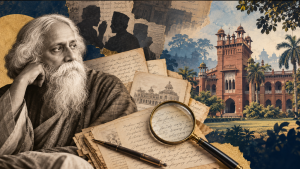
Separating Historical Evidence from Political Myth
| ABSTRACT
Did Rabindranath Tagore oppose the establishment of the University of Dhaka? This article examines a persistent allegation that the Bengali poet resisted the proposed university and even presided over a protest meeting in Kolkata in March 1912. Reviewing the institutional history of Dhaka University, later historical commentary and the chronology of Tagore’s movements, it finds no convincing documentary evidence substantiating his alleged participation. The article distinguishes the well-documented opposition to the university among some influential Calcutta circles from the separate, unverified claim that Tagore himself led that opposition, arguing for a historical standard based on primary evidence, chronology and acknowledged uncertainty. |
Introduction: A Controversy That Demands Evidence
Did Rabindranath Tagore, the Nobel Prize-winning poet and one of Bengal’s greatest intellectual figures, oppose the establishment of the University of Dhaka? For years, this allegation has circulated in public discussions, newspaper commentaries and social media debates. Some accounts even attribute to him the statement, “What need is there for a university in a land of fools?” Others claim that he presided over a protest meeting in Kolkata in 1912 against the proposed university.
These are serious allegations. If true, they would raise important questions about Tagore’s political outlook, his relationship with East Bengal and his understanding of educational opportunity. However, historical reputations should not be shaped by allegations alone. They must be examined against documentary evidence, contemporary records and credible historical research.
An examination of the available sources suggests that there is no convincing evidence establishing that Tagore opposed the founding of Dhaka University. Although opposition to the proposed institution did exist among influential circles in Kolkata, attributing that opposition to Tagore requires evidence that the allegation’s proponents have not convincingly produced.
The distinction between a documented historical event and an unverified claim is essential to understanding this controversy.
The Historical Context: Why Was Dhaka University Proposed?
The origins of the University of Dhaka must be understood within the political and educational circumstances of early twentieth-century Bengal.
The partition of Bengal in 1905 created the province of Eastern Bengal and Assam, with Dhaka as its capital. The partition was annulled in 1911, generating disappointment among sections of East Bengal’s population who had anticipated greater administrative attention and educational development.
On 31 January 1912, a delegation led by Nawab Sir Salimullah, Nawab Syed Nawab Ali Chowdhury and A. K. Fazlul Huq met Viceroy Lord Hardinge during his visit to Dhaka. The delegation raised the demand for a university in the region. On 2 February, the Government of India announced its decision to recommend the establishment of a university at Dhaka.
According to the University of Dhaka’s official historical outline, the Government of Bengal subsequently appointed a committee under Sir Robert Nathan on 27 May 1912 to prepare a comprehensive plan for the proposed institution. The Nathan Committee submitted its recommendations that year, and its report was published for public consideration in 1913.
The proposal nevertheless encountered political and institutional resistance. Some influential figures in Calcutta feared that a university in Dhaka could weaken the position of the University of Calcutta or alter the existing balance of educational influence in Bengal.
Historian and commentator accounts of the university’s origins document this opposition. In particular, The Daily Star, in its article “University of Dhaka and the partitioning of Bengal”, discusses the objections raised by some Hindu leaders in Calcutta, including concerns that a separate university in Dhaka could amount to an “internal partition of Bengal.”
This opposition is part of the historical record. The unresolved question, however, is whether Rabindranath Tagore personally participated in it.
The Allegation Against Tagore: What Is Its Source?
One frequently cited account attributes Tagore’s alleged opposition to a meeting at Garer Math, now associated with Kolkata’s Brigade Parade Ground, on 28 March 1912. According to this narrative, Tagore presided over a gathering organised to protest against the proposed University of Dhaka.
The claim is discussed in a 2000 book by retired Major General M. A. Matin, Amader Swadhinata Sangramer Dharabahikata ebong Prasangik Kichhu Katha. The problem is that the account, as examined in subsequent commentary, does not provide a verifiable contemporary source establishing Tagore’s participation.
In the article “Rabindranath and Dhaka University”, published in Dhaka Tribune in May 2018, the author examines the allegation and highlights the absence of supporting documentation. The article also points to evidence from Tagore’s biographical record that conflicts with the claim about the March meeting.
A more recent discussion, Syed Mehdi Momin’s “Debunking myths about Tagore”, published in Dhaka Herald, similarly questions the allegation and notes that the evidence placing Tagore in Shilaidaha contradicts the story that he chaired the Kolkata gathering.
A further assertion circulating in public discourse attributes insulting remarks about the people of East Bengal to Tagore. Yet no reliable contemporary document has been established in the sources examined here to authenticate the quotation.
An allegation repeated in multiple publications does not automatically become a historical fact. Unless an original letter, newspaper report, signed petition, meeting record or other credible contemporary document can be produced, the quotation should not be presented as Tagore’s verified words.
| “An allegation repeated in multiple publications does not automatically become a historical fact.” |
The Crucial Question of 28 March 1912
The chronology of Tagore’s movements provides an important test of the allegation.
According to the historical accounts cited by Dhaka Tribune and Dhaka Herald, Tagore left Kolkata on 24 March 1912 and stayed at Shilaidaha, in present-day Kushtia, until 12 April. He was recovering from illness after cancelling a planned voyage to England.
The accounts refer to Tagore’s dated poems and songs from this period, which identify Shilaidaha as the place of composition. This evidence places him away from Kolkata on 28 March, the date on which the alleged protest meeting was supposedly held.
If that chronology is correct, Tagore could not simultaneously have been in Shilaidaha and presiding over a meeting in Kolkata.
This is more than a disagreement over interpretation. It is a factual inconsistency that requires the proponents of the allegation to provide additional evidence if they wish to sustain their claim.
There is, however, an important distinction to make. The evidence undermines the specific allegation concerning 28 March; it does not, by itself, establish every aspect of Tagore’s private views on the university proposal. A responsible historical assessment should avoid making claims broader than the evidence permits.
The Confusion Between 16 February and 28 March
One source of confusion is the existence of more than one date associated with opposition to the university proposal.
The Daily Star account records that a delegation of Hindu leaders from Calcutta approached Lord Hardinge on 16 February 1912 to express concerns about the proposed institution. The article discusses the argument that a separate university in Dhaka might deepen divisions within Bengal.
That event must not be confused with the separate allegation that Tagore presided over a protest meeting at Garer Math on 28 March.
Evidence that a delegation opposed the proposal on 16 February does not establish that Tagore was a member of that delegation. Similarly, the documented existence of opposition in Calcutta cannot be used to prove that every prominent Bengali intellectual supported it.
The distinction is fundamental: the opposition was real, but Tagore’s alleged personal involvement remains unsubstantiated by the evidence identified in the sources reviewed here.
Historical analysis becomes unreliable when the actions of one group are automatically attributed to an individual because of his social background, religious association or political reputation.
Tagore’s Relationship with Dhaka University
Tagore’s later relationship with Dhaka University offers additional context, although it should not be treated as conclusive proof of his private views in 1912.
In February 1926, Tagore visited Dhaka and received a warm welcome. Accounts of the visit describe receptions organised by the university community and his stay aboard the Turag, a houseboat associated with the Nawab of Dhaka. His visit demonstrated that he was welcomed by important sections of Dhaka’s cultural and academic community.
The history of this relationship is discussed in the Dhaka Tribune article cited above and in Dhaka Herald’s account of the controversy.
In 1936, the University of Dhaka conferred an honorary Doctor of Literature degree on Tagore, according to the latter account.
These events do not logically prove that Tagore could never have disagreed with the university’s establishment in an earlier period. Institutions and individuals can maintain cordial relationships despite historical disagreements. Nevertheless, the reception Tagore received in Dhaka and the university’s subsequent recognition of his literary achievements are relevant to any balanced assessment of the allegation that he maintained an established campaign against the institution.
The evidence therefore supports a more nuanced conclusion than the portrayal of Tagore as an unequivocal enemy of higher education in East Bengal.
Why Does the Allegation Continue to Circulate?
The persistence of the allegation may be connected to the wider political and cultural debates surrounding Tagore’s legacy.
Tagore opposed the partition of Bengal in 1905, although his position was shaped by his concerns about division and communal relations. Critics have sometimes linked that opposition to the later controversy surrounding Dhaka University.
But opposition to the partition of Bengal and opposition to the establishment of a university in Dhaka are two different propositions. One cannot establish the second merely by demonstrating the first.
Tagore’s identity as a prominent Bengali Hindu intellectual has also been used in arguments that interpret the university controversy through religious and regional divisions. Such interpretations risk replacing evidence with assumptions about how a person must have thought or acted because of his background.
This does not mean that the historical politics surrounding the establishment of Dhaka University should be ignored. The institution emerged from a contested political environment in which educational opportunity, regional representation, communal relations and the distribution of institutional power were closely connected.
Those issues deserve serious study. But they should be investigated through documentary evidence and historical scholarship rather than simplified into accusations against an individual.
Dhaka University’s Establishment: The Documented Record
The institutional chronology is considerably clearer than the controversy surrounding Tagore.
The University of Dhaka’s official historical record identifies the major milestones: the proposal in 1912, the Nathan Committee’s work, the subsequent review of the scheme and the passage of the Dacca University Act of 1920.
The university began its academic journey on 1 July 1921, initially with three faculties—Arts, Science and Law—and twelve departments.
These facts are documented in the university’s official historical outline. Additional context is available in The Daily Star’s “The conception and birth of Dhaka University”.
The establishment of the university was a significant development in the educational history of eastern Bengal. Its significance does not depend on proving or disproving a particular allegation against Tagore. Rather, it rests on the institutional achievement itself and the aspirations for higher education that helped bring it into existence.
Conclusion: History Must Be Established by Evidence, Not Repetition
Did Rabindranath Tagore oppose the establishment of Dhaka University?
Based on the sources examined, the allegation is not established by convincing documentary evidence. The frequently repeated story that he presided over a protest meeting at Garer Math on 28 March 1912 conflicts with accounts placing him at Shilaidaha during that period. The alleged quotation about the people of East Bengal also lacks reliable verification in the sources reviewed.
At the same time, it would be excessive to claim that every question about Tagore’s private views has been conclusively settled. The appropriate conclusion is narrower and more defensible: there is documented evidence of opposition to the proposed university, but the evidence identified here does not substantiate Tagore’s alleged participation in that opposition.
The distinction matters because historical inquiry should not become an exercise in defending or discrediting cultural icons. Tagore’s literary achievements do not make him immune to criticism, just as his background does not establish guilt by association.
Dhaka University’s history deserves an honest account of the resistance it encountered, the political circumstances of its establishment and the aspirations of the people who demanded it. Tagore’s place in that history should likewise be determined by verifiable records.
The standard should be straightforward: identify the original source, test its claims against contemporary evidence, distinguish documented facts from inference and acknowledge uncertainty where it remains.
Until credible primary evidence demonstrates otherwise, the claim that Rabindranath Tagore actively opposed the establishment of Dhaka University should be treated as an unsubstantiated historical allegation—not as an established fact.
References and Further Reading
University of Dhaka. “Historical Outline.” Official institutional history, including the 1912 proposal, the Nathan Committee, the 1920 Act and the university’s opening in 1921.
https://www.du.ac.bd/university/HistoricalOutline
Rahman, Asahabur. “Rabindranath and Dhaka University.” Dhaka Tribune, 14 May 2018. Examines the allegation about Tagore’s supposed participation in the 1912 protest and the evidence concerning his whereabouts.
https://www.dhakatribune.com/arts-and-letters/145501/rabindranath-and-dhaka-university
The Daily Star. “University of Dhaka and the partitioning of Bengal.” Historical discussion of the university proposal and opposition from some leaders in Calcutta.
https://www.thedailystar.net/historical/star-weekend/news/university-dhaka-and-the-partitioning-bengal-1453546
The Daily Star. “The conception and birth of Dhaka University.” A historical account of the institutional process leading to the university’s establishment.
https://www.thedailystar.net/youth/education/campus/news/the-conception-and-birth-dhaka-university-2121841
Momin, Syed Mehdi. “Debunking myths about Tagore.” Dhaka Herald, published 24 June 2026 and subsequently updated. Discusses the allegation, Tagore’s whereabouts in March 1912 and his later relationship with Dhaka University.
https://en.dhakaherald.net/un-seo-title/43
Matin, M. A. Amader Swadhinata Sangramer Dharabahikata ebong Prasangik Kichhu Katha. Ahmad Publishing House, Dhaka, 2000. This is the book identified in later commentary as a source of the allegation. The specific claim should be checked against the original edition and any primary sources it cites.

Md Shakil Talukdar
Md Shakil is a distinguished researcher, columnist, and human rights activist with over 14 years of experience spanning academia, international relations, and professional journalism.
With a robust background in academia, Shakil has served as a Lecturer in Finance at City University and a Visiting Faculty member at Sher-E-Bangla Agricultural University. He is an accomplished author of numerous international journal publications and a regular columnist for national and International dailies, where he analyzes geopolitics and social justice.
His scholarly work is extensive, with numerous publications in international journals covering diverse topics such as the Blue Economy, international trade, microfinance, and sustainable agriculture
He spearheaded human rights initiatives as a Program Manager for ELCOP. He holds an MBM from BUBT, a BBA from City University, and was awarded an Honorary Doctorate of Humanity in 2022 for his extensive social contributions. He is an active member of the Bangladesh Economic Association, Asiatic Society of Bangladesh and Amnesty International.