

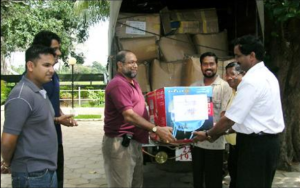
Source: Forum Yarl Ajith Boyagoda in Killinocchi in 2005
“A Long Watch” is the memoir of Commodore Ajith Boyagoda, who spent eight years in captivity by the Liberation Tigers of Tamil Eelam (LTTE) in the war-ravaged northern region of Sri Lanka from 1994 until his release in 2002. The book, first published in 2016 by C. Hurst & Co. in London, UK, was written by Cambridge-educated theatre director, dramaturg and writer Sunila Galappatti. This review is written retrospectively, while also making diachronical and intertextual references to Kagusthan Ariaratnam’s memoir “Spy Tiger 05 Files” previously reviewed by myself for South Asia Democratic Forum.
Ajith Boyagoda was only 20 years old in 1974 when he decided that he would join the Sri Lanka navy as a young cadet. He journeyed into an illustrious naval career, serving in 1983 as head of the naval detachment at Nainativu, an island off the coast of the Jaffna peninsula. His role was to provide protection to the priests of a Buddhist temple in the island at the behest of the government. The backdrop to this was the Sinhala-Tamil riots, which later became a full-scale civil war. Nainativu island had both a Buddhist temple and a Hindu kovil. Boyagoda makes a keen observation that the fishing and farming folk lived harmoniously with the Buddhist priests, paying them homage. This relationship was altered due to the presence of the military; this foregrounded the gradual hardening of ethnic anxieties and a climate of reciprocal mistrust between Sinhalese and Tamil communities. After voyaging abroad for foreign training and serving elsewhere in the country, Boyagoda returned to Karinagar in 1991, where the Sri Lankan army had stormed through civilian houses, looting their belongings (pg 45-47). He, as second in command in charge of administrating the city, focused his efforts on family reunification, a service which later redeemed him in the eyes of the tigers who captured and took him as prisoner of war (POW).
In 1993 Boyagoda joined the largest ship in the possession of the Sri Lanka navy, the SLNS Sagarawardena, where he served as the captain. The ship was preparing to escort a fuel convoy on the morning of 20th September 1994 when it was sunk by the LTTE’s elite Under Water Demolition Team and Suicide Boat Squadron, as recounted in both The 05 File (pg. 86) and A Long Watch (pg 59-60). Oppilan aka Ariaratnam was then a young LTTE intelligence wing cadre who was gathering intelligence on the Sri Lankan navy to launch precision suicide strikes. The Tigers had wanted to make as many attacks as possible to weaken the government of Sri Lanka and force it to negotiate ahead of the 1994 presidential elections. The capture of the Sagarawardena and its captain was a major victory for the LTTE and a major loss for the government forces. Boyagoda remained a high-profile prisoner of war until the 2002 ceasefire, when he was released through a prisoner swap (Captain Boyagoda for LTTE’s Black Tiger Kennedy, aka Jesumy Fernando). Boyagoda, along with other POWs, had gone on a publicized hunger strike to help the LTTE accelerate release negotiations with the government.
In both books, the treatment of Boyagoda as a prisoner of war by the LTTE was recounted as humane or even special. Ariaratnam narrates that Boyagoda was treated according to his rank and was kept in the Jaffna Intelligence Wing Prison, where they met regularly to learn about international conventional navies and about the Sri Lanka navy. Boyagoda had received training by American, British, Indian and Pakistani navies (pg 87). In A Long Watch, Boyagoda largely corroborates Oppilan’s story; Oppilan, under the guidance of Sasikumar master, interviewed Boyagoda along with Nala, Krishna, Mangalika and other young cadres to gather information. They had bought questionnaires with them, amicably referring to him as “Appa”, which means ‘father’ in Tamil (pg 91 and 93). Oppilan then contacted Boyagoda through Facebook in 2010, years after his release, telling him how he was betrayed by Sasikumar master1 upon discovering his love affair with Nala and the subsequent defection to the Sri Lankan Directorate of Military Intelligence (pg 201).
The LTTE used Boyagoda during his captivity for propaganda purposes, as explained in the memoir. The memoir also corroborated events in Sri Lanka’s history such as President Ranasinghe Premadasa’s clandestine dealings with the LTTE in 1989 to rid the country of the Indian Peacekeeping Force (IPKF; pg 80). The LTTE propaganda arm had conducted extensive interviews with him for the Eelanatham paper, particularly images of him appearing alongside the representatives of the International Committee of the Red Cross (ICRC), to demonstrate that their treatment was humane (pg 87, 97). An important event narrated in this book is the LTTE mock trial of Boyagoda for war crimes and civilian massacres that occurred in the Kilali lagoon. He was absolved of all crimes upon receiving testimonies of his services to the Tamil people in Karainagar and Analaitivu. He was able to gain enough confidence by the LTTE to be offered a job as an LTTE spy in the Sri Lankan armed forces. Had he taken that opportunity, he would have been released way earlier than the 8 long years in captivity. However, Boyagoda refused multiple times. Such an account also lends credibility to Oppilan’s memoir, particularly his claim that the LTTE sought to infiltrate the Sri Lankan armed forces through him.
Up until the publication of A Long Watch, Boyagoda was largely overlooked as a heroic figure in Sri Lanka’s wartime history since he was never part of the final assault against the LTTE in 2008-2009. Upon return from his captivity in the South, he was denied promotions, duties and even met an awkward end to his naval career. His memoir is also testimony to the difficulties that his family went through, particularly the children who were bullied in school by other students and even teachers. Sunila Galappatti writes in an autobiographical voice that “the story of the Sagarawardena was a story I read, long before it was a story I told..I was found guilty of negligence by a board of inquiry while I was in captivity” (pg 69). A closed-door inquiry was held after his release. The Sagarwardena’s Communicator, who had survived the sinking, presented crucial documentary evidence from the ship’s log book absolving Boyagoda of all criminal negligence. Boyagoda’s compassion towards his captors was demonstrated years after his release, when he distributed relief aid in Kilinocchi after the 2004 Tsunami. Below is an internet forum excerpt translated from Tamil:
“This is Ajith Boyagoda , the ship captain of the Sinhalese Navy ship ‘ Sakarawardhana ‘, which was sunk by pirates in 1994. He brought relief supplies to Kilinochchi on a Wednesday in the month of Thaimatham in 2005 … after the tsunami that shook Tamil Eelam. The point to note here is that he was once a prisoner of war of the LTTE. He was captured alive …by the female commander …Lt. Col. Nalayini”
Throughout the memoir, Boyagoda conveys testimony to protracted violence through different episodes in his life, including the 1971 and 1989 JVP insurrections, the1983 Sinhala-Tamil riots and civil war. He mentions having encountered dead bodies burning in tires in 1989 on the roads of Colombo, police brutality towards insurrectionists at the Peradeniya campus – and other forgotten murders by insurrectionists such as that of Gladys Jayawardene, the then chairman of the State Pharmaceutical Corporation. He also remembers the LTTE massacre of 147 boys and men in a mosque in Kattankudy in 1990, the assassinations of Rajiv Gandhi in 1991 and Ranasinghe Premadasa in 1993, and the LTTE’s cruel and inhumane torture of other POWs of less strategic advantage to them than him during his captivity. He notes in page 138 that many of the credulous young men who joined the LTTE cause were tired and yearned for a different kind of life, for a family, instead of wasting away their youth. This was largely the case in the story of Oppilan as embodied in The 05 File. Oppilan escaped the conflict from one side to the other and arrived in Canada to find a home. One notable quote from A Long Watch captured Sri Lanka’s political trajectory throughout the years:
“You see how difficult it is for an elected government to keep popular support for more than a decade. How much less likely is it then that a self-appointed militia would keep the support of its people? There is a time limit to anyone’s tolerance to anything.” (pg 185).
***
Special note: The author acknowledges the Noolaham Foundation for its longstanding efforts to preserve the digital archives of the Eelanatham newspaper, recognizing that the conservation of LTTE-era newspapers and websites are an invaluable resource for researchers worldwide.
Note1: In Sri Lankan English, cadres refer to their superiors in the form of their name followed by the qualifier ‘master’: in this case, Sasikumar master.
Natasha Fernando
Nathasha Fernando is currently a PhD candidate in études du religieux contemporain (contemporary religious studies) at Université de Sherbrooke (University of Sherbrooke) in Quebec Canada. She is based in Montreal city undertaking a study on the evolution of the discourse of terrorism, victimhood and reconciliation in Sri Lanka and among its diaspora in Canada. Her current PhD research focus is on the intersection of memory politics and mass incidents of violence. Her research interests span terrorism and political violence with an emphasis on religio-political discourse. Her academic objectives are to develop area studies expertise focused on South Asia. She has full professional proficiency in English, Sinhala and French. Her articles are catalogued at MuckRuck (https://muckrack.com/nathasha-fernando-1) and ORCID (https://orcid.org/0000-0002-0606-7893).