

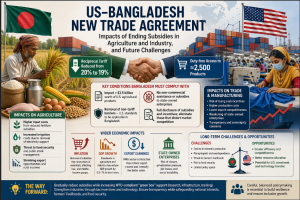
On February 9, 2026, Bangladesh’s interim government signed a bilateral trade agreement with the United States. This agreement has sparked widespread debate regarding Bangladesh’s autonomy in economic policymaking and its sovereignty (CPD April 19, 2026). As an apparent concession, the United States reduced reciprocal tariffs on Bangladeshi goods from 20 percent to 19 percent and granted duty-free access to approximately 2,500 products (Daily Sun February 11,2026). However, the conditions Bangladesh must comply with in return could have far-reaching impacts on the country’s agriculture and overall trade and commerce. Analysts suggest that this agreement poses a significant risk to the country’s agricultural sector, particularly for marginal farmers. Food security, local production, and the stability of the rural economy could all come under pressure as a result.
A closer look at the structure of the agreement reveals that, in the name of maintaining trade balance, Bangladesh has had to accept several stringent conditions. With the liberalization of the agricultural market, U.S. products such as wheat, soybeans, corn, dairy items, meat, and fruits will now be able to enter the Bangladeshi market with greater ease. Moreover, the commitment to import approximately $3.5 billion worth of agricultural goods makes the agreement even more one-sided (The White House February 9, 2026). The removal of non-tariff barriers further implies that U.S. standards and sanitary regulations will be directly applicable in Bangladesh, intensifying competition for local producers.
In the broader context of global geopolitics and geoeconomics, trade relations between Bangladesh and the United States have entered a new phase. The recently disclosed terms of the bilateral agreement are highly sensitive for Bangladesh’s domestic economy, especially for agriculture and manufacturing sectors. According to the agreement, Bangladesh will no longer be allowed to provide non-commercial assistance or any form of subsidies to its state-owned enterprises. Additionally, detailed information on subsidies and incentives provided to domestic manufacturing industries must be disclosed to the United States, and any subsidies that distort market competition must be eliminated. These restrictions present a significant economic and policy challenge for a developing country like Bangladesh.
Under such circumstances, small and marginal farmers are likely to suffer the most. Due to heavy subsidies and advanced technology in the U.S. agricultural sector, their products are comparatively cheaper. Competing with such low-priced imports will be nearly impossible for Bangladeshi farmers. A decline in prices of products such as milk, meat, and eggs would directly reduce farmers’ incomes, affecting nearly 38 percent of the population that depends on agriculture for their livelihood (The Financial Express)
At the same time, production costs have already increased due to rising fuel prices, fertilizer costs, and irrigation constraints. The influx of cheaper foreign goods under these conditions may force many farmers out of production, leading to a decline in domestic output and posing long-term risks to food security.
- Potential Impacts on the Agricultural Sector: A Blow to the Backbone?
Agriculture remains the backbone of Bangladesh’s economy, with a large portion of the population dependent on it for survival. If these conditions are implemented, the sector could face significant transformation.
- Fertilizer Subsidies and Production Costs :The government currently spends billions in subsidies each year to ensure farmers can access fertilizers at lower prices. Under WTO rules and U.S. conditions, direct input subsidies may need to be reduced. Any increase in fertilizer prices would immediately raise production costs, potentially devastating small-scale farmers. b. Irrigation and Electricity Support: Subsidized electricity for irrigation pumps may be categorized as “non-commercial support.” If irrigation costs rise, rice production costs will increase, potentially destabilizing the rice market. c. Food Security and Public Stock Management:
If state institutions (such as the Directorate General of Food) are unable to purchase rice from farmers at higher prices and sell it at subsidized rates through OMS or rationing systems, the government’s ability to regulate the market will weaken. This could threaten long-term food security. d. Shrinking Export Opportunities: Bangladesh exports frozen foods, jute goods, and processed agricultural products to markets in the U.S. and Europe. Without competitive subsidies, production costs will rise, making it difficult to remain competitive against countries like India, Vietnam, and Thailand, which continue to support their agricultural sectors.
- Transformation in Trade and Manufacturing
Bangladesh’s export earnings are largely driven by the ready-made garment (RMG) sector, along with emerging industries such as leather, plastics, and pharmaceuticals, many of which rely on government incentives.
- Risk of Losing Cash Incentives: The government currently provides cash incentives to boost exports. Under the agreement, such incentives that affect market competition must be eliminated. This may increase the price of Bangladeshi goods in international markets, weakening competitiveness against countries like Vietnam and India. b. Decline in Export Incentives: According to Bangladesh Bank, substantial funds are spent annually on export incentives. If these are withdrawn, the RMG sector could be severely affected, leading to reduced orders and export earnings. c. Weakening of State-Owned Enterprises: State-owned enterprises such as BRTC, BSFIC, and TCB have long operated at a loss but survived through government support. With subsidies removed, many of these institutions may face closure or large-scale layoffs, increasing unemployment. d. Investment and Technology Transfer: on the positive side, the agreement may encourage market reforms and transparency, potentially attracting U.S. investment. However, in the short term, domestic industries may struggle to adapt. e. Transparency and Sovereignty Concerns :The requirement to disclose detailed subsidy information to the United States raises concerns about economic sovereignty and the exposure of sensitive industrial data and strategic planning.
- Future of State-Owned Enterprises
Institutions like BTMC, BCIC, and state-run sugar mills have survived despite chronic losses due to government support.
Risk of Closure: Without subsidies, these entities may not survive in a competitive market, leading to layoffs and underutilized national assets. Privatization Pressure: The agreement may indirectly push toward privatization, which could improve efficiency in the long term but may cause short-term unemployment and social instability.
- Macroeconomic Impacts
- Inflation: The removal of subsidies may increase the prices of essential goods, placing pressure on lower- and middle-income groups.
- GDP Growth: Slowdowns in agriculture and industry may reduce GDP growth. According to World Bank estimates, subsidy withdrawal could reduce growth by 0.5–1% in the short term.
- Decline in Export Earnings: A contraction in the RMG sector could reduce export income and intensify the dollar crisis.
- WTO Obligations and Transparency
The agreement requires Bangladesh to submit detailed subsidy information to the WTO within six months. As the country transitions from Least Developed Country (LDC) status, there is already pressure to reduce subsidies. This bilateral agreement accelerates and intensifies that process, limiting the government’s ability to provide targeted support.
- Long-Term Challenges and Opportunities
While removing subsidies may not be entirely negative, and could bring some benefits:
Enhanced Competitiveness: Industries may become more efficient and less dependent on subsidies. Better Resource Allocation: Funds saved from subsidies could be invested in education, healthcare, and infrastructure.
However, timing is crucial. Without ensuring alternative income sources for farmers or improving industrial capacity, implementing such conditions could destabilize the rural economy.
Bangladesh’s growing dependence on imports may deepen under this agreement. Currently, about 80% of wheat demand is met through imports (The daily Star). With domestic production at around 1.25 million tons against a demand of 7.5 million tons, imports—particularly from the U.S.—may increase further (New Age). At the same time, irrigation constraints and fertilizer shortages may reduce Boro rice production, potentially increasing rice imports to around 1.5 million tons.
This dual pressure of declining production and rising imports could place the economy in a vulnerable position. Overdependence on a single country has historically created market instability, as seen in the cases of onions, sugar, and wheat. Therefore, an agreement that opens markets without adequate protection could weaken domestic agriculture and industry in the long run.
Given these realities, calls from economists and business leaders to review the agreement are not unreasonable. Without ensuring farmer protection, full market liberalization may threaten food security.
Conclusion
This agreement with the United States represents a significant test of Bangladesh’s economic diplomacy. To safeguard agriculture and trade, the government must adopt a dual strategy: gradually reduce direct subsidies while increasing WTO-compliant “green box” support (such as research, infrastructure development, and training). At the same time, domestic industries should be strengthened through tax incentives and technological support.
While ensuring compliance with transparency requirements, it is essential to protect national interests. Although the Bangladesh–U.S. trade agreement may open new avenues for economic cooperation, its impacts are not uniformly positive. A careful and in-depth assessment, particularly of its long-term effects on agriculture, is crucial.
Now is the time for realistic and balanced policymaking to protect domestic production, farmers’ livelihoods, and national food security.
Reference List:
Bangladesh Bank. (2023). রপ্তানি প্রণোদনা ও ভর্তুকি সংক্রান্ত বার্ষিক প্রতিবেদন [Annual report on export incentives and subsidies]. Bangladesh Bank.
Bangladesh Sangbad Sangstha (BSS). (n.d.). Govt allocates Tk 27,224cr for agriculture sector.
Bee Global Trade Finance. (2026). Bangladesh Bank export incentives for FY2026 [LinkedIn post].
Center for Policy Dialogue (CPD). (n.d.). বৈষম্যমূলক ও ঝুঁকিপূর্ণ বাণিজ্যচুক্তি পুনর্বিবেচনা করা উচিত [Discriminatory and risky trade agreement should be reconsidered].
Center for Policy Dialogue (CPD). (n.d.). Implications of WTO compliance for Bangladesh’s industrial subsidies.
Daily Sun. (n.d.). US-Bangladesh trade deal: Tariff relief comes at high cost?
Export Promotion Bureau (EPB), Bangladesh. (n.d.). Export incentives.
International Monetary Fund (IMF). (n.d.). Bangladesh country reports. https://www.imf.org/en/Countries/BGD
LexBlog. (n.d.). United States and Bangladesh to sign an agreement on reciprocal trade.
Liberty News. (n.d.). Govt forms committee to boost export potential post-LDC.
Moneycontrol. (n.d.). US-Bangladesh trade framework: Dhaka opens up dairy, poultry sectors to American imports.
New Age. (n.d.). Reciprocity in name, asymmetry in reality.
The Daily Star. (n.d.). Economic news on subsidies.
The Daily Star. (n.d.). Next budget must be designed for LDC graduation.
The Daily Star. (n.d.). US trade deal may force Bangladesh to cut subsidies.
The Daily Star Bangla. (n.d.). যুক্তরাষ্ট্রের সঙ্গে বাণিজ্যচুক্তি: শর্তের বেড়াজালে পড়বে বাংলাদেশ?
The World Bank. (2022). Subsidy reform in South Asia: Impacts on agriculture and trade. https://www.worldbank.org
United States Department of State. (n.d.). Bangladesh investment climate statement. https://www.state.gov
White House. (2026, February). Joint statement on framework for United States–Bangladesh agreement on reciprocal trade. https://www.whitehouse.gov/briefings-statements/2026/02/joint-statement-on-framework-for-united-states-bangladesh-agreement-on-reciprocal-trade/
World Trade Organization (WTO). (n.d.). Agreement on subsidies and countervailing measures. https://www.wto.org

Md Shakil Talukdar
Md Shakil is a distinguished researcher, columnist, and human rights activist with over 14 years of experience spanning academia, international relations, and professional journalism.
With a robust background in academia, Shakil has served as a Lecturer in Finance at City University and a Visiting Faculty member at Sher-E-Bangla Agricultural University. He is an accomplished author of numerous international journal publications and a regular columnist for national and International dailies, where he analyzes geopolitics and social justice.
His scholarly work is extensive, with numerous publications in international journals covering diverse topics such as the Blue Economy, international trade, microfinance, and sustainable agriculture
He spearheaded human rights initiatives as a Program Manager for ELCOP. He holds an MBM from BUBT, a BBA from City University, and was awarded an Honorary Doctorate of Humanity in 2022 for his extensive social contributions. He is an active member of the Bangladesh Economic Association, Asiatic Society of Bangladesh and Amnesty International.