

Standfirst
Cox’s Bazar’s domestic popularity has yet to translate into a clearly measured international leisure market. This article examines how transport, visitor services, destination positioning, environmental management and fragmented governance may constrain demand. Drawing on recent research and institutional reporting, it argues that sustainable growth depends on the complete visitor journey and on retaining tourism spending within local communities. Better data must distinguish foreign leisure tourists from visitors travelling for work, business or humanitarian purposes. The proposed framework connects competitiveness with visitor demand, local enterprise, employment and coastal protection. It offers a research agenda and policy priorities rather than original survey findings or causal estimates of tourism’s economic impact.
“The development of international tourism should therefore be understood as a destination-management challenge rather than merely a marketing challenge.”
JEL codes: L83; O18; O44; F14; R11.
Keywords: Cox’s Bazar; international tourist demand; destination competitiveness; tourism-led growth; local value capture; economic leakage; sustainable tourism.
1. Introduction
Tourism connects visitor demand with accommodation, transport, food services, recreation, retail, and cultural and nature-based experiences. When visitors are non-residents, spending can be recorded as exports of travel-related services. Tourism can also create indirect demand for local agriculture, fisheries, crafts, transport, and other suppliers. Yet its economic impact is not automatic: it depends on demand composition, local participation, and management of social and environmental costs (Alcalá-Ordóñez & Segarra, 2025; World Bank, n.d.).
Cox’s Bazar is a prominent coastal destination in Bangladesh. Its domestic visibility, however, does not necessarily translate into international leisure demand. International visitors compare the complete trip experience: awareness, planning, transport, booking confidence, service quality, cleanliness, safety, activities, value for money, and credible information. The issue is whether the destination can convert its natural and cultural assets into a competitive and dependable international visitor experience.
This paper develops the theme of the author’s earlier research manuscript on destination competitiveness and tourism sustainability. It asks why international leisure demand may be limited, how international tourism can contribute to economic growth, and what policies could improve competitiveness without undermining coastal assets. A methodological distinction is essential: foreign arrivals may include work, business, humanitarian, family, or other travel purposes. A recent report states that local agencies do not maintain a reliable separate count of foreign leisure tourists in Cox’s Bazar (Deb, 2026). Thus, limited leisure demand is treated as a research concern, while its precise scale and causes require dedicated measurement.
2. Study Objectives
- Review recent evidence on destination competitiveness, international demand, tourism-led growth, and sustainability.
- Identify plausible destination-level barriers to international leisure tourists’ selection of Cox’s Bazar.
- Explain channels through which international tourism may support national and local economic growth.
- Develop a conceptual framework and propositions for empirical testing.
- Recommend measures to improve demand, local economic retention, and sustainable destination management.
3. Literature Review
3.1 Destination competitiveness and the visitor journey
Destination competitiveness is increasingly understood as a system rather than a single attraction or marketing outcome. International visitor choice can be shaped by accessibility, information quality, service reliability, product variety, value for money, destination image, and trust. These factors interact along the journey from awareness to booking, arrival, consumption, and recommendation. Promotion alone may be insufficient where travel friction, service inconsistencies, or environmental conditions weaken the experience.
A 2026 Cox’s Bazar service-quality study reports stronger satisfaction in hotel cleanliness and staff behavior, but lower satisfaction in scam control, public toilets, beach shower facilities, and night safety (Pramanik et al., 2026). These results identify destination-quality dimensions worth studying. They do not directly prove international tourists’ perceptions unless the study’s respondent sample specifically establishes that.
3.2 Tourism-led growth and development
The tourism-led growth hypothesis proposes that tourism expansion can contribute to economic growth. A review of 82 peer-reviewed empirical studies published during 2014–2022 documents continuing research on the hypothesis while emphasizing differences in measures, methods, and destination contexts (Alcalá-Ordóñez et al., 2024). A related review of 57 studies finds that tourism can be associated with poverty reduction, lower inequality, and improved living conditions, although such development outcomes depend on how benefits are distributed and connected to local economies (Alcalá-Ordóñez & Segarra, 2025).
These findings support a cautious conclusion: tourism can contribute to growth, but an increase in arrivals does not necessarily create a proportional increase in local welfare. Accurate impact assessment requires attention to dynamic relationships, spillovers, local linkages, and the possibility that economic growth itself attracts tourism. A 2022 systematic review calls for stronger methods to assess tourism’s economic effects, including dynamic and spatial impacts (Toward an Accurate Assessment of Tourism Economic Impact, 2022).
3.3 Leakage and local value capture
Gross visitor expenditure is not equivalent to local income. Spending may leave through imported inputs, external ownership, profit repatriation, non-local intermediaries, or weak local sourcing. Chaitanya and Swain (2024) review tourism leakage and emphasize its relevance to destination development. Cox’s Bazar’s economic impact should therefore be assessed through local procurement, business ownership, wages, trip duration, expenditure categories, and supplier linkages—not visitor totals alone.
3.4 Sustainability and destination resilience
Cox’s Bazar-specific evidence links tourism development to environmental and socio-cultural management. Hossain et al. (2025) developed a Geospatially Adaptive Tourism Sustainability Index using economic, environmental, socio-cultural, and peripheral indicators. The study reported an average score of 2.63, categorized as medium sustainability, with variation among sites and comparatively weaker socio-cultural and peripheral indicators. An average can therefore conceal local differences.
The ILO’s 2025–2027 Destination Development Plan identifies eight high-potential destinations across Cox’s Bazar and emphasizes environmental stewardship, community-based tourism, and economic opportunities for women and youth. It also describes tourism coordination structures as mechanisms for integrated destination planning (International Labour Organization [ILO], 2025). This supports a destination-system approach to international competitiveness.
3.5 Research gap
Recent research and plans address sustainability, visitor services, local development, and destination planning, but several gaps remain. First, local counts do not consistently distinguish international leisure tourists from foreign nationals visiting for other purposes. Second, visitor-service research does not necessarily isolate international tourists or non-visitors who considered and rejected Cox’s Bazar. Third, the relationship between international visitor spending and local economic retention has not been established by the sources reviewed here. Fourth, tourism-growth literature supports potential benefits, but a destination-specific causal estimate requires reliable data and a suitable research design.
This paper connects demand constraints, competitiveness, economic channels, leakage, and sustainability in a single conceptual framework. It does not report original survey results or a causal estimate.
3.6 Conceptual Framework and Sustainable Model
The framework links destination competitiveness and perceived sustainability to international demand, then links visitation to economic outcomes. Local value capture and sustainability governance are moderators.
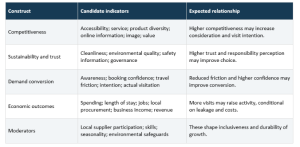
Note. Source: Author synthesis based on Hossain et al. (2025), ILO (2025), Pramanik et al. (2026), and tourism-growth/leakage literature. Conceptual framework, not an estimated model.
3.7 Sustainable Tourism Development Framework
The sustainable tourism framework explains how tourism development should balance economic, environmental, and socio-cultural objectives. The framework is particularly relevant to Cox’s Bazar because tourism growth depends on the long-term conservation of coastal and marine resources. The model proposes that tourism development should produce economic benefits while protecting the environmental and cultural resources that support the destination. The World Tourism Organization’s sustainable tourism definition similarly emphasizes economic viability, environmental conservation, and the needs of host communities and visitors. UNESCO World Heritage Centre.
3.8 Integrated conceptual research model
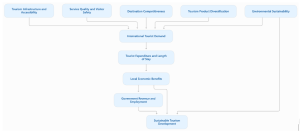
Figure 1. Integrated conceptual research model. Source: author’s supplied manuscript.
- The model illustrates the proposed relationship between destination competitiveness, international tourist demand, economic benefits, and sustainable tourism development.
- The model assumes that infrastructure, service quality, environmental sustainability, and product diversification influence international tourist demand.
- Higher international tourist demand may increase visitor expenditure and length of stay, thereby generating greater economic benefits for local businesses, employment, and public revenue.
- However, tourism development is sustainable only when economic benefits are balanced with environmental protection and community welfare
4. Recent Evidence and Context
The following table combines indicators from different geographies and statistical concepts. They are not interchangeable; national foreign-visitor arrivals should not be interpreted as Cox’s Bazar leisure-tourist arrivals.
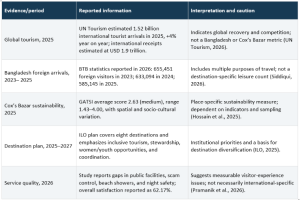
Note. Sources: UN Tourism (2026); Bangladesh Tourism Board statistics as reported by Siddiqui (2026); Hossain et al. (2025); ILO (2025); Pramanik et al. (2026). Original definitions and sample scope should be checked.
5. Recent condition of tourism in Cox’s Bazar
5.1 Tourism demand and the domestic market
Cox’s Bazar is one of Bangladesh’s most prominent domestic tourism destinations. The principal tourism areas include Laboni, Sugandha, Kolatoli, Kalatali, Inani, Himchari, and Marine Drive. The destination also has opportunities for tourism development in Maheshkhali, Sonadia, Ramu, and other surrounding areas.
The domestic tourism market is driven by several factors:
- The natural attraction of the beach.
- Family holidays and recreational travel.
- Religious and public holidays.
- School, college, and university vacations.
- Corporate and institutional travel.
- Improved road, rail, and air connectivity.
- The growing popularity of short domestic holidays.
Recent reporting demonstrates the scale of domestic demand. During Eid-ul-Fitr in April 2025, accommodation establishments in Cox’s Bazar reported approximately 90% advance bookings. The president of the Hotel, Motel, and Guesthouse Owners’ Association stated that more than 500 establishments were operating and that their combined accommodation capacity could reach approximately 187,000 guests per day (United News of Bangladesh [UNB], 2025). During Eid-ul-Adha in June 2025, industry estimates suggested that approximately 400,000 tourists visited Cox’s Bazar over seven days. Businesses reported strong sales and full accommodation bookings. However, the report also emphasized that there were no comprehensive official figures for the exact number of daily visitors or their spending patterns (The Business Standard, 2025a).
These findings suggest that Cox’s Bazar possesses a substantial domestic tourism market. However, the market is highly seasonal, with demand concentrated around holidays and weekends. The seasonality of tourism creates operational difficulties. Hotels may experience high occupancy during holidays but low occupancy during ordinary weekdays or periods of political uncertainty, adverse weather, and economic pressure. For example, industry reports in June 2024 indicated that advance hotel bookings had declined to approximately 33%–35%, compared with 60%–65% in previous years before the Eid holidays. Hotel operators attributed the decline partly to inflation and reduced household spending (The Business Standard, 2024).
This evidence demonstrates that tourism demand in Cox’s Bazar is sensitive to household purchasing power and economic conditions.
5.2 Recent accommodation capacity
Accommodation capacity is a major indicator of tourism development. It determines how many visitors can stay overnight and influences the economic benefits generated through hotel services, restaurants, transportation, and other tourism activities.
Recent sources provide the following estimates.
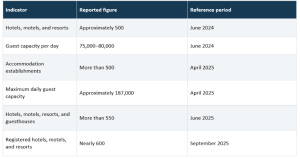
Sources: The Business Standard (2024); UNB (2025); The Business Standard (2025a); bdnews24.com (2025).
The variation in these figures should not be interpreted as a precise measurement of annual growth. The sources use different establishment categories and reporting methods. The September 2025 report stated that Cox’s Bazar had nearly 600 registered hotels, motels, and resorts. It also reported that the Kolatoli area alone contained 538 hotels, motels, resorts, and cottages according to the local hotel owners’ association (bdnews24.com, 2025). The Kolatoli figure illustrates the concentration of accommodation facilities in a relatively small geographical area. However, it also raises an important planning question: whether the growth of accommodation capacity has been matched by sufficient investment in sewage treatment, solid-waste management, roads, public facilities, environmental protection, and destination governance.
The empirical evidence suggests that accommodation expansion has been more visible than the development of integrated destination infrastructure.
5.3 The difference between hotel capacity and tourism quality
A destination’s tourism competitiveness cannot be assessed solely by counting hotels.
Hotel capacity measures the supply of accommodation. Tourism quality depends on a broader range of factors, including:
- Cleanliness and environmental conditions.
- Safety and security.
- Hospitality and professional service.
- Transport accessibility.
- Public toilets and shower facilities.
- Recreational and cultural attractions.
- Digital information and booking services.
- Food safety and visitor convenience.
- Environmental protection and destination management.
A destination may have hundreds of hotels but still fail to attract international visitors if its tourism experience is not sufficiently differentiated. This distinction is particularly important for Cox’s Bazar. The area has experienced substantial accommodation development, but international tourism remains weak. Recent reporting describes the expansion of high-rise buildings and unplanned construction around the beach. Environmentalists have warned that the increasing concentration of concrete structures is reducing the natural attractiveness of the destination (bdnews24.com, 2025). The long-term competitiveness of Cox’s Bazar therefore depends not merely on increasing the number of hotels but on improving the quality and sustainability of the overall tourism experience.
5.4 Tourism business turnover
Tourism creates economic activity through accommodation, restaurants, transport, retail, entertainment, and other services. A report published by The Bangladesh Monitor in January 2025 stated that hotels, motels, restaurants, and other tourism businesses in Cox’s Bazar generated approximately BDT 1,600 crore in business turnover over the two weeks ending December 27, 2024. Accommodation establishments alone reportedly generated approximately BDT 210 crore during that period (The Bangladesh Monitor, 2025). These figures indicate the economic significance of peak-season tourism.
However, the reported turnover represents gross business activity rather than net income, value added, or government tax revenue. It should not be interpreted as the direct contribution of tourism to GDP. Business turnover includes expenditure on goods and services that may originate outside the destination. For example, hotels may purchase imported equipment, fuel, food products, or other inputs from suppliers outside Cox’s Bazar. Consequently, the net local economic benefit depends on the extent to which tourism expenditure remains within the local economy. A sustainable tourism strategy should therefore increase local procurement, community participation, locally owned businesses, and the development of tourism-related supply chains.
5.5 Tourism sustainability: Recent empirical findings
The sustainability of tourism in Cox’s Bazar has become an increasingly important research issue. Hossain et al. (2025) developed a Geospatially Adaptive Tourism Sustainability Index (GATSI) to assess tourism sustainability in Cox’s Bazar.
The study evaluated 30 economic, environmental, socio-cultural, and peripheral indicators.
The findings reported:
- An average sustainability score of 2.63.
- A minimum score of 1.43.
- A maximum score of 4.00.
- Moderate sustainability in certain island, sanctuary, and park tourism areas.
- Low or extremely low sustainability in several cultural and nature-based tourism settings.
The average score of 2.63 was classified as indicating medium sustainability. The findings suggest that sustainability performance differs significantly across geographical areas and tourism types. This is an important empirical result because it demonstrates that tourism sustainability is not uniform throughout Cox’s Bazar. Some areas may possess comparatively better infrastructure and economic activity, while other areas face difficulties related to community engagement, governance, environmental protection, and the management of tourism resources. Bhuiyan and Bhuiyan (2023) similarly assessed the sustainability conditions of Cox’s Bazar through a mixed-method approach. Their findings indicated an intermediate level of sustainability, suggesting that the destination could not be considered fully sustainable or completely unsustainable. Together, these studies indicate that Cox’s Bazar is experiencing a transition in which tourism growth has created economic opportunities but has not yet been accompanied by sufficiently strong sustainability systems.
6. International tourism and the limited attraction of foreign tourists
6.1 The difference between foreign visitors and foreign leisure tourists
One of the most important empirical issues in Cox’s Bazar tourism research is the absence of reliable data on international leisure tourists.
A foreign visitor may travel to Cox’s Bazar for several reasons:
- Leisure and holiday tourism.
- Business and investment.
- Humanitarian and development work.
- International organizational assignments.
- Research and academic activities.
- Family visits or other personal purposes.
These categories have different economic implications.
For example, a foreign development worker staying in Cox’s Bazar for several months may contribute to hotel revenue, restaurants, transport, and other services. However, this person should not automatically be classified as an international leisure tourist. A recent investigation by bdnews24.com reported that district administration officials, airport authorities, hotel operators, and the Bangladesh Parjatan Corporation did not have a reliable count of foreign tourists visiting Cox’s Bazar specifically for leisure purposes. The investigation found that many foreign nationals in Cox’s Bazar were connected with development projects, international organizations, or work associated with the Rohingya camps. Authorities were unable to distinguish these visitors systematically from international leisure tourists (bdnews24.com, 2026a). This finding is important for tourism planning because it indicates that Cox’s Bazar lacks a sufficiently developed international visitor-monitoring system.
6.2 National inbound tourism statistics
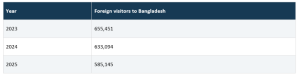
National inbound tourism statistics provide a broader indication of Bangladesh’s international tourism performance. According to figures attributed to the Bangladesh Tourism Board and prepared using Special Branch of Police statistics, Bangladesh received the following numbers of foreign visitors:
Source: The Business Standard (2026).
The figures show a decline in foreign visitor arrivals between 2023 and 2025. The decline from 2024 to 2025 was approximately 7.6%. However, these national figures should not be used as estimates of foreign tourist arrivals in Cox’s Bazar. They include foreign visitors travelling to different destinations and for different purposes. The national statistics nevertheless provide an important context: Bangladesh’s international visitor market has not yet demonstrated consistently strong growth, and Cox’s Bazar faces an additional challenge in converting its domestic popularity into international demand.
6.3 Why foreign tourists are not sufficiently attracted to Cox’s Bazar
The limited attraction of international leisure tourists is associated with several interconnected factors.
6.3.1 Inadequate international destination positioning
Cox’s Bazar has considerable natural appeal, but its international marketing and destination positioning remain insufficiently developed. The destination is frequently promoted primarily as a long natural beach. However, international tourists often seek a broader travel experience that combines natural landscapes, cultural attractions, recreation, gastronomy, wellness, adventure, and convenient travel arrangements. The lack of a distinctive international tourism identity limits Cox’s Bazar’s ability to compete with established destinations in South and Southeast Asia. Recent reporting indicates that tourism experts consider inadequate international promotion and insufficient destination infrastructure to be major obstacles to foreign-tourist attraction (bdnews24.com, 2026a). A stronger international tourism brand should therefore communicate the wider experiences available in Cox’s Bazar rather than relying exclusively on its beach.
6.3.2 Limited tourism-product diversification
A major challenge is the concentration of tourism activities around the beach.
Although Cox’s Bazar possesses hills, forests, islands, fishing communities, cultural traditions, marine resources, and coastal landscapes, these assets have not been developed into a sufficiently integrated tourism product.
The ILO’s Destination Development Plan for Cox’s Bazar (2025–2027) identifies eight high-potential destinations:
- Sonadia Island.
- Mini Bandarban.
The plan identifies opportunities for sustainable and community-based tourism through environmental stewardship, cultural value, accessibility, and local participation (ILO, 2025). These destinations could provide international visitors with a diversified experience involving coastal nature, island exploration, cultural tourism, local food, community interaction, and ecotourism. However, diversification must be supported by environmental assessments and appropriate visitor-management systems.
6.3.3 Environmental degradation and overcrowding
The natural environment is the central tourism asset of Cox’s Bazar. Unplanned construction, plastic pollution, inadequate waste collection, overcrowding, and poor sewage management threaten the quality of the tourism experience. Recent reporting has highlighted concerns regarding the increasing concentration of high-rise buildings around the beach and the insufficient management of tourism-related waste (bdnews24.com, 2025). Environmental degradation can affect international demand through several mechanisms.
First, visitors may perceive the destination as less attractive. Second, pollution and overcrowding can reduce visitor satisfaction. Third, poor environmental management may damage the destination’s international reputation. Fourth, environmental degradation can increase the long-term cost of maintaining tourism infrastructure.
International tourists who prioritize nature-based tourism may be particularly sensitive to these problems. Therefore, environmental protection should be regarded as a tourism investment rather than merely a regulatory responsibility.
6.3.4 Safety and security concerns
Safety is an essential factor in international tourism decisions.
Foreign visitors may be concerned about personal security, transport reliability, tourist harassment, beach safety, emergency medical services, and access to reliable information. Recent tourism research and industry reporting have identified safety and security as important factors influencing the attractiveness of Cox’s Bazar (ILO, 2024; bdnews24.com, 2025).
The destination requires an integrated visitor-safety system involving:
- Tourist police.
- Trained lifeguards.
- Emergency response services.
- Licensed transport providers.
- Reliable complaint mechanisms.
- Public information systems.
- Multilingual tourist assistance.
A well-managed safety system can improve visitor confidence and support repeat tourism.
6.3.5 Service-quality gaps
The quality of tourism services influences visitor satisfaction, destination reputation, and the likelihood of repeat visits. A recent empirical study by Pramanik et al. (2026) examined service quality and sustainable tourism planning in Cox’s Bazar. The study reported an overall visitor satisfaction level of approximately 62.17%.
It identified relatively strong performance in:
- Hotel cleanliness: 72.30%.
- Staff behaviour: 75.83%.
- Regional transport affordability: approximately 68.56%–68.94%.
However, the study identified substantial weaknesses in:
- Scam control: 21.45%.
- Public toilets: 20.65%.
- Beach shower facilities: 18.23%.
- Night safety: 41.78%.
These findings demonstrate that the tourism experience is characterized by a mixture of strengths and weaknesses. Hospitality and hotel services may be comparatively satisfactory, while public infrastructure and destination governance remain problematic. This distinction is significant because international visitors experience the destination as a complete tourism system rather than as an individual hotel.
6.3.6 Limited international transport connectivity
Transport connectivity is another important factor influencing international tourism. Foreign tourists may require convenient access through international flights, reliable domestic connections, clear transport information, and efficient transfers between the airport, hotels, and attractions. Although Cox’s Bazar has air, road, and rail connections, the international tourism market requires more than the physical presence of transport infrastructure.
Connectivity must be supported by:
- Convenient international travel arrangements.
- Reliable domestic flight schedules.
- Efficient airport services.
- Integrated transport booking.
- Safe and predictable transfers.
- Clear information for foreign visitors.
Recent reporting indicates that international airport development and improved regional connectivity have been discussed as part of the government’s ambition to develop Cox’s Bazar into an international tourism destination (bdnews24.com, 2026b).
However, transport investment should be coordinated with tourism product development, environmental protection, and destination management.
6.3.7 Insufficient tourism infrastructure and public facilities
Public facilities are essential for maintaining a high-quality tourism experience. These include public toilets, changing rooms, showers, waste collection facilities, pedestrian routes, signage, tourist information centres, and accessible infrastructure. The service-quality findings reported by Pramanik et al. (2026) indicate that public toilets and beach showers are among the weakest elements of the visitor experience. These deficiencies may appear relatively minor compared with hotels or airports, but they can significantly affect the perceived quality of the destination. The international competitiveness of Cox’s Bazar therefore depends on improving the entire tourism environment.
6.3.8 International positioning and discoverability
Cox’s Bazar may be perceived mainly as a domestic beach destination rather than an internationally differentiated multi-experience destination. A clear itinerary linking coastal nature, culture, food, community experiences, and wider Bangladesh destinations may improve consideration. The ILO plan indicates a broader destination portfolio is possible, but market fit and readiness require testing (ILO, 2025).
7. Economic Importance of International Tourism
7.1 Foreign-exchange receipts
Non-resident visitor spending can generate travel-service export receipts and diversify export earnings. The magnitude depends on visitor numbers, average expenditure, length of stay, and spending mix. Bangladesh should separate arrivals by purpose, while Cox’s Bazar should develop destination-specific expenditure estimates before quantifying this channel.
7.2 Employment and entrepreneurship
International demand can support direct jobs in accommodation, food, transport, guiding, recreation, retail, and maintenance, and indirect jobs among suppliers. Local small businesses can benefit from visitor purchases and tourism firms’ procurement. The ILO plan’s focus on women and youth points to an inclusive-development pathway (ILO, 2025). Job quality, wages, seasonality, skills, gender, and local ownership should be monitored.
7.3 Local multipliers and leakage
Tourism income circulates locally when businesses purchase local inputs and workers spend earnings in the region. Imported inputs and external ownership can reduce retention. An impact study should combine visitor expenditure with business procurement and employment data. Literature supports tourism’s growth potential but stresses contextual variation and leakage (Alcalá-Ordóñez et al., 2024; Chaitanya & Swain, 2024).
7.4 Investment and public revenue
Predictable demand may encourage investment in accommodation, transport, visitor facilities, digital services, and workforce development. Tourism activity can contribute to relevant public revenue through applicable taxes and fees. Benefits must be balanced against public infrastructure costs and environmental externalities.
7.5 Regional diversification and resilience
International tourism can diversify the coastal economy and create markets for local products and services. However, tourism is vulnerable to seasonality, shocks, environmental change, and geopolitical or health events. Resilience requires market and product diversification, local supplier capacity, and protection of environmental assets.
8. How to Improve International Tourism
8.1 Establish reliable data
Distinguish international leisure tourists from business, work, humanitarian, family, and other visitors. Combine airport, accommodation, tour operator, and visitor survey information with privacy safeguards. Core indicators should include residence, trip purpose, length of stay, expenditure, accommodation, repeat visit, and satisfaction.
8.2 Improve the visitor journey
Map the journey from pre-trip discovery through booking, arrival, local mobility, activities, emergency support, and departure. Improve multilingual information, transparent prices, booking confidence, transport guidance, visitor help, and complaint resolution. Select interventions using measured pain points.
8.3 Develop a differentiated portfolio
Position the destination around coastal nature, beach recreation, cuisine, culture, community experiences, and responsible nature-based itineraries. Connect attractions and businesses into bookable products and involve communities in design and benefit sharing. The ILO plan provides a foundation for destination development (ILO, 2025).
8.4 Upgrade public amenities and governance
Prioritize public toilets, sanitation, waste and wastewater management, beach safety, signage, public-space maintenance, and visitor mobility. Strengthen coordination among authorities, tourism agencies, businesses, and communities. Publish a service-quality dashboard.
8.5 Increase local value capture
Develop local supplier capability in food, crafts, transport, maintenance, cultural services, and other inputs. Encourage local procurement and training. Track local jobs, wages, women/youth participation, and ownership alongside arrivals.
8.6 Segment markets and promote responsibly
Select source markets based on motivations, access, spending, seasonality, and product fit. Promotion should communicate credible experiences and connect to accurate booking information. Avoid demand generation that exceeds infrastructure or environmental capacity.
8.7 Protect coastal assets
Tourism planning should include environmental safeguards, carrying-capacity considerations, coastal risk management, ecosystem protection, and community participation. Sustainability protects the natural resource base and the quality of life on which tourism depends.
9. Strategies to attract international tourists and develop sustainable tourism
9.1 Develop an international destination brand
Cox’s Bazar should develop an international tourism brand that emphasizes its natural environment, coastal experiences, local culture, and sustainable tourism opportunities.
The branding strategy should move beyond the traditional promotion of the beach alone.
A broader brand identity could include:
- Coastal and marine tourism.
- Nature-based tourism.
- Cultural and heritage tourism.
- Community-based tourism.
- Wellness and relaxation.
- Adventure and recreational tourism.
The destination should be promoted through international travel platforms, tourism exhibitions, travel agencies, digital marketing, and partnerships with international tour operators.
The marketing strategy should be supported by actual improvements in the visitor experience. International promotion without adequate service quality and environmental management may create negative visitor experiences and damage destination reputation.
9.2 Improve international accessibility
International accessibility should be improved through coordinated transport planning.
The key priorities include:
- More convenient international travel arrangements.
- Improved domestic air and rail connections.
- Reliable airport transfers.
- Integrated transport information.
- Safe and licensed tourist transportation.
- Improved road connectivity to surrounding attractions.
The development of Cox’s Bazar as an international tourism destination requires transport infrastructure that is reliable, affordable, and environmentally responsible.
9.3 Establish an integrated tourism information system
Cox’s Bazar requires a comprehensive tourism database.
The database should record:
- Domestic tourist arrivals.
- International leisure tourist arrivals.
- Foreign visitors travelling for business or other purposes.
- Accommodation capacity.
- Hotel occupancy rates.
- Average length of stay.
- Visitor expenditure.
- Tourism employment.
- Tourism business turnover.
- Environmental indicators.
A digital visitor-registration and tourism-statistics system could improve the reliability of tourism planning. Accommodation establishments should be encouraged to report standardized information through a secure and regularly updated platform. The system should protect personal information and use aggregated statistics for tourism planning. The distinction between foreign leisure tourists and other foreign visitors is particularly important. Without this distinction, the government cannot accurately assess the international tourism performance of Cox’s Bazar.
9.4 Develop diversified tourism products
Cox’s Bazar should develop tourism products that encourage visitors to stay longer and explore a wider geographical area. The ILO’s Destination Development Plan provides a foundation for developing tourism opportunities in Pechardwip, Sonadia Island, Maheshkhali, Ramu, Himchari, Inani, Patuartek, and Mini Bandarban (ILO, 2025).
Potential tourism products include:
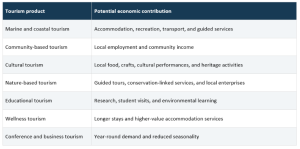
The development of these products should be based on environmental carrying capacity, community participation, and appropriate infrastructure.
9.5 Improve tourism service quality
Service-quality improvement should be a central component of tourism development.
The recent service-quality findings of Pramanik et al. (2026) suggest that public facilities, scam control, beach showers, and night safety require substantial improvement.
The government and private sector should therefore prioritize:
- Modern public toilets.
- Clean changing rooms.
- Beach shower facilities.
- Reliable tourist information centres.
- Licensed transport providers.
- Transparent pricing.
- Professional tour guides.
- Multilingual signage.
- Tourist complaint mechanisms.
- Improved emergency response services.
Service-quality standards should be monitored through regular visitor surveys.
Hotels and tourism businesses should also receive professional training in hospitality, customer service, food safety, and environmental management.
9.6 Promote green investment and sustainable accommodation
Tourism investment should prioritize environmental performance.
Hotels, resorts, and guesthouses should be encouraged to adopt:
- Energy-efficient lighting and equipment.
- Water-efficient systems.
- Renewable energy where feasible.
- Wastewater treatment.
- Waste segregation.
- Plastic reduction.
- Environmental management systems.
- Sustainable procurement.
Green investment incentives should be linked to measurable environmental performance rather than simply to the construction of new accommodation.
The government should also ensure that tourism development complies with applicable environmental regulations and coastal protection requirements.
9.7 Strengthen local economic participation
The economic benefits of tourism should be distributed more broadly across local communities.
Tourism businesses should be encouraged to source food, handicrafts, cultural products, and other services from local suppliers.
Training programmes should focus on women, youth, and disadvantaged communities.
The ILO’s tourism and skills initiatives provide a relevant foundation for strengthening employment opportunities and local economic participation in Cox’s Bazar (ILO, 2024, 2025).
A more inclusive tourism economy could improve household income, reduce economic vulnerability, and strengthen local support for sustainable tourism.
9.8 Develop a year-round tourism strategy
Cox’s Bazar should reduce its dependence on holiday tourism.
A year-round tourism strategy could include:
- Cultural events.
- Nature-based tourism.
- Educational and research tourism.
- Wellness tourism.
- Conferences and business events.
- Community-based tourism.
- Seasonal recreational activities.
The strategy should be based on the destination’s climate, environmental conditions, and visitor preferences.
Reducing seasonality would help tourism businesses maintain more stable employment and improve the utilization of existing accommodation capacity.
9.9 Establish measurable tourism sustainability indicators
Tourism development should be monitored through a set of measurable indicators.
The following framework is proposed for Cox’s Bazar.
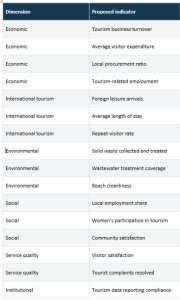
The indicators should be measured regularly and published through a tourism sustainability dashboard.
This would improve transparency and support evidence-based decision-making.
9.10 Empirical discussion and policy implications
The empirical evidence indicates that tourism in Cox’s Bazar is characterized by a combination of strong domestic demand and weak international competitiveness. The domestic market has demonstrated substantial capacity to generate business turnover, particularly during holidays. Recent accommodation estimates indicate that the destination has hundreds of hotels, motels, resorts, and guesthouses, with considerable daily accommodation capacity. However, the expansion of accommodation has not necessarily translated into an equivalent improvement in tourism quality.
The evidence suggests that Cox’s Bazar faces several structural challenges:
- Unplanned tourism development.
- Insufficient environmental management.
- Weak international destination positioning.
- Limited diversification of tourism products.
- Uneven service quality.
- Inadequate public facilities.
- Seasonal demand.
- Weak tourism statistics.
- Limited integration of local communities into tourism value chains.
These challenges have implications for tourism investment and public policy.
The government should avoid treating the number of hotel buildings as the principal measure of tourism development. Instead, tourism development should be evaluated through economic value added, visitor satisfaction, international competitiveness, environmental sustainability, employment quality, and local economic participation. The evidence also suggests that Cox’s Bazar does not necessarily require unlimited growth in accommodation capacity. A more effective strategy may involve improving the quality of existing accommodation, developing diversified tourism products, strengthening public infrastructure, and improving environmental management. The destination should pursue a tourism model in which economic growth is supported by the conservation of natural resources. This is particularly important because the environmental quality of Cox’s Bazar is central to its long-term tourism competitiveness. The development of international tourism should therefore be understood as a destination-management challenge rather than merely a marketing challenge. International promotion, transport connectivity, service quality, safety, environmental protection, and local economic participation must operate as an integrated system. The reviewed evidence supports a systemic interpretation of Cox’s Bazar’s international tourism challenge. Natural and cultural assets must be converted into a clear, accessible, reliable, and sustainable visitor proposition. Recent destination-specific studies identify service and sustainability dimensions that can be measured and addressed, while the ILO planning framework emphasizes coordination, community participation, and inclusive opportunities. The economic case is meaningful but conditional. International visitors can generate service-export receipts and demand for local firms, yet actual development impact depends on local sourcing, job quality, investment, public management, and environmental safeguards. National tourism-growth findings justify investigation; they do not provide an unmeasured GDP effect for Cox’s Bazar. National foreign-visitor counts should not be treated as destination-specific leisure arrivals. A promotion-only approach risks creating awareness without conversion or local welfare. A more credible strategy combines data, journey improvements, product development, service standards, governance, local supply chains, and environmental protection.
10. Conclusion
Cox’s Bazar’s international tourism opportunity is a destination-conversion and sustainable-value-capture challenge. International tourists may be less likely to select the destination when access, information, services, product differentiation, perceived reliability, and management do not meet expectations. These explanations are plausible and require direct testing with visitors and non-visitors.
International tourism can support Bangladesh through service-export receipts, employment, enterprise income, investment, public revenue, and local supply chains. The inclusiveness and durability of these gains depend on local retention of spending and protection of coastal assets. Cox’s Bazar should pursue international tourism through a coordinated system that measures the market, improves the visitor journey, strengthens local linkages, and safeguards environmental and community interests.
References
Alcalá-Ordóñez, A., Brida, J. G., & Cárdenas-García, P. J. (2024). Has the tourism-led growth hypothesis been confirmed? Evidence from an updated literature review. Current Issues in Tourism, 27(22), 3571–3607. https://doi.org/10.1080/13683500.2023.2272730
Alcalá-Ordóñez, A., & Segarra, V. (2025). Tourism and economic development: A literature review to highlight main empirical findings. Tourism Economics, 31(1). https://doi.org/10.1177/13548166231219638
Bangladesh Oceanographic Research Institute. (2024). Annual report 2023–2024. https://bori.gov.bd/
Barua, P., Bhowmik, P. K., Sonia, K. A., Rashid, A. M. M. F., & Sulaiman, M. (2026). Waste-to-wealth: Impact of source sorting of household waste in Cox’s Bazar Municipality. International Growth Centre. https://bigd.bracu.ac.bd/publications/waste-to-wealth-impact-of-source-sorting-of-household-waste-in-coxs-bazar-municipality/
Bhuiyan, M. R. U., & Bhuiyan, M. B. (2023). Crises and conflicts on the way to sustainable tourism development: A study of Cox’s Bazar, Bangladesh. Journal of Environmental Management and Tourism, 14(2), 320–334. https://doi.org/10.14505/jemt.v14.2(66).03 bdnews24.com. (2025, September 27). As concrete crowds out nature in Cox’s Bazar, foreign tourists stay away. https://bdnews24.com/travelandtourism/375cca34c6f2 bdnews24.com. (2026a, July 24). Government rethinks coastal curbs as Cox’s Bazar tourism masterplan takes shape. https://bdnews24.com/bangladesh/4b0858a0fa5a bdnews24.com. (2026b, September 27). Tourism Day: Cox’s Bazar has many foreign visitors. But how many are tourists? https://bdnews24.com/travelandtourism/c7g8rl8cvp
Chaitanya, A. V. K., & Swain, S. K. (2024). Economic leakages in tourism: A comprehensive review of theoretical and empirical perspectives. Tourism Economics. https://doi.org/10.1177/13548166231204648
Crouch, G. I., & Ritchie, J. R. B. (1999). Tourism, competitiveness, and societal prosperity. Journal of Business Research, 44(3), 137–152. https://doi.org/10.1016/S0148-2963(97)00196-3
Deb, S. (2026, September 27). Tourism Day: Cox’s Bazar has many foreign visitors. But how many are tourists? bdnews24.com. https://bdnews24.com/travelandtourism/c7g8rl8cvp
Dwyer, L., & Kim, C. (2003). Destination competitiveness: Determinants and indicators. Current Issues in Tourism, 6(5), 369–414. https://doi.org/10.1080/13683500308667962
Enright, M. J., & Newton, J. (2004). Tourism destination competitiveness: A quantitative approach. Tourism Management, 25(6), 777–788. https://doi.org/10.1016/j.tourman.2004.06.008
Hasan, M. K., Abdullah, S. K., Lew, T.-Y., & Islam, M. F. (2019). Tourists’ satisfaction and destination loyalty: A case study on Cox’s Bazar beach of Bangladesh. International Journal of Leisure and Tourism Marketing, 6(3/4), 174–193. https://doi.org/10.1504/IJLTM.2019.103542
Hossain, M. A., Islam, M. R., Yesmin, T., & Hasan, M. H. (2025). Development and application of the GATSI in measuring tourism sustainability in Cox’s Bazar, Bangladesh. Geomatics, 77(1), Article 100041. https://doi.org/10.1016/j.geomat.2024.100041
International Labour Organization. (2024). Bangladesh skills assessment: Chattogram and Cox’s Bazar—Summary report. https://www.ilo.org/
International Labour Organization. (2025, November 12). Destination development plan for Cox’s Bazar (2025–2027). https://www.ilo.org/publications/destination-development-plan-coxs-bazar
Mawa, J. (2019). Factors influencing tourist’s satisfaction based on service attributes of hotels: A study on Cox’s Bazar, Bangladesh. Journal of Business Management and Accounting, 9(1), 27–54. https://doi.org/10.32890/jbma2019.9.1.8744
Pramanik, M. A., Islam, M. A., Kayes, A. N. M., Mahmud, M. H., Tuba, K. M. H., & Shahajahan, T. B. (2026). GIS-based hybrid modelling for sustainable tourism planning and service quality gap assessment in Cox’s Bazar, Bangladesh. Nexus Sustainability. https://doi.org/10.1016/j.nxsust.2026.100554
Sahabuddin, M., Tan, Q., Hossain, I., Alam, M. S., & Nekmahmud, M. (2021). Tourist environmentally responsible behavior and satisfaction: Study on the world’s longest natural sea beach, Cox’s Bazar, Bangladesh. Sustainability, 13(16), Article 9383. https://doi.org/10.3390/su13169383
Siddiqui, K. (2026, September 15). Foreign tourist arrivals down 7.6% in 2025 as Indian visitors slump. The Business Standard. https://www.tbsnews.net/bangladesh/foreign-tourist-arrivals-down-76-2025-indian-visitors-slump-1542956
Song, H., & Witt, S. F. (2003). A model of demand for international tourism. Annals of Tourism Research, 30(1), 31–49. https://doi.org/10.1016/S0160-7383(02)00029-4
The Bangladesh Monitor. (2025, January 1). Hotels, motels, restaurants in Cox’s Bazar witness turnover of BDT 210cr. https://www.bangladeshmonitor.com.bd/hotel-pdf/hotels-motels-restaurants-in-coxs-bazar-witness-turnover-of-bdt-210cr
The Business Standard. (2024, June 17). Eid tourism bookings dip, hotel owners blame inflation. https://www.tbsnews.net/bangladesh/eid-tourism-bookings-dip-hotel-owners-blame-inflation-878621
The Business Standard. (2025a, June 14). 4 lakh tourists visit Cox’s Bazar in a week, business hits Tk400cr. https://www.tbsnews.net/bangladesh/4-lakh-tourists-visit-coxs-bazar-week-business-hits-tk400cr-1164666
The Business Standard. (2025b, April 2). Cox’s Bazar sees massive tourist influx during Eid vacation. https://www.tbsnews.net/bangladesh/coxs-bazar-sees-massive-tourist-influx-during-eid-vacation-1106386
The Business Standard. (2026, September 15). Foreign tourist arrivals down 7.6% in 2025 as Indian visitors slump. https://www.tbsnews.net/bangladesh/foreign-tourist-arrivals-down-76-2025-indian-visitors-slump-1542956
Toward an accurate assessment of tourism economic impact: A systematic literature review. (2022). Annals of Tourism Research Empirical Insights, 3(2), Article 100054. https://doi.org/10.1016/j.annale.2022.100054
UN Tourism. (2026, January 20). International tourist arrivals up 4% in 2025 reflecting strong travel demand around the world. https://www.untourism.int/news/international-tourist-arrivals-up-4-in-2025-reflecting-strong-travel-demand-around-the-world
World Bank. (n.d.). Tourism. https://www.worldbank.org/ext/en/topic/tourism
World Travel & Tourism Council. (2026). Travel & tourism economic impact research. https://wttc.org/Research/Economic-Impact
Foundational and supporting references
Crouch, G. I., & Ritchie, J. R. B. (1999). Tourism, competitiveness, and societal prosperity. Journal of Business Research, 44(3), 137–152. https://doi.org/10.1016/S0148-2963(97)00196-3
Dwyer, L., & Kim, C. (2003). Destination competitiveness: Determinants and indicators. Current Issues in Tourism, 6(5), 369–414. https://doi.org/10.1080/13683500308667962
Enright, M. J., & Newton, J. (2004). Tourism destination competitiveness: A quantitative approach. Tourism Management, 25(6), 777–788. https://doi.org/10.1016/j.tourman.2004.06.008
Hasan, M. K., Abdullah, S. K., Lew, T.-Y., & Islam, M. F. (2019). Tourists’ satisfaction and destination loyalty: A case study on Cox’s Bazar beach of Bangladesh. International Journal of Leisure and Tourism Marketing, 6(3/4), 174–193. https://doi.org/10.1504/IJLTM.2019.103542
Mawa, J. (2019). Factors influencing tourist’s satisfaction based on service attributes of hotels: A study on Cox’s Bazar, Bangladesh. Journal of Business Management and Accounting, 9(1), 27–54. https://doi.org/10.32890/jbma2019.9.1.8744
Song, H., & Witt, S. F. (2003). A model of demand for international tourism. Annals of Tourism Research, 30(1), 31–49. https://doi.org/10.1016/S0160-7383(02)00029-4
Suggested citation
Parvez, M. S. (2026). Unlocking international tourism in Cox’s Bazar, Bangladesh 2026: Barriers to international tourist demand and the contribution of international tourism to sustainable economic growth. South Asia Democratic Forum (SADF).

Shahriar Parvez
Prof. Md. Shahriar Parvez is an international academic, researcher, development economist, education leader, and motivational speaker with over two decades of experience in higher education, research, and institutional leadership.
He is the Founder and Chairman of the Independent Perception and Research Hub (IPRH) Bangladesh and holds several international academic and advisory roles.
His work focuses on development economics, business education, human resource development, organizational leadership, and policy research.
He has published widely in national and international journals and has received several honours, including the Chancellor’s Gold Medal and honorary doctoral distinctions.
Committed to education, social development, and global citizenship, he continues to promote knowledge, innovation, and sustainable development through international collaboration.