

Youth Protest, Political Economy and EU–India Relations After the “Cockroach” Summer – WP 37
What began as a judge’s insult about “cockroaches” became a youth movement capable of forcing a minister’s resignation, testing India’s democratic institutions, and potentially complicating the EU’s most ambitious new partnership in South Asia.
Abstract
In May 2026, a dismissive remark by India's Chief Justice comparing unemployed youth to "cockroaches" triggered...

Bangladesh’s FY2026–27 Budget: Navigating Macroeconomic Rebalancing, Fiscal Consolidation, and Financial Sector Reforms — A...
Bangladesh’s FY2026–27 national budget is being formulated at a pivotal juncture, marked by heightened macroeconomic imbalances, constrained fiscal space, external sector pressures, and structural weaknesses across revenue administration and financial intermediation. In this context, the upcoming budget is expected to function not merely as an expenditure framework but as...
War, Captivity and Return in Sri Lanka – An “emic view” into the life...
Source: Forum Yarl Ajith Boyagoda in Killinocchi in 2005
“A Long Watch” is the memoir of Commodore Ajith Boyagoda, who spent eight years in captivity by the Liberation Tigers of Tamil Eelam (LTTE) in the war-ravaged northern region of Sri Lanka from 1994 until his release in 2002. The book,...
US–Bangladesh New Trade Agreement: Impacts of Ending Subsidies in Agriculture and Industry, and Future...
On February 9, 2026, Bangladesh’s interim government signed a bilateral trade agreement with the United States. This agreement has sparked widespread debate regarding Bangladesh’s autonomy in economic policymaking and its sovereignty (CPD April 19, 2026). As an apparent concession, the United States reduced reciprocal tariffs on Bangladeshi goods from...
Iran, Israel, and US War: South Asian Migrant Workers and the Need for a...
Introduction:
“It was nothing like any sound I have heard before in my life,” said Vikrant, a 28-year-old Dubai-based Indian delivery worker, recalling the thunder of explosions when Iranian drones struck the United Arab Emirates (Kumar, 2026). Fearing for his safety, he shared only his first name. Today, Vikrant’s anxiety...
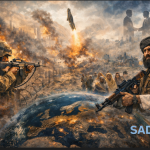
SADF NEWSLETTER South Asia Weekly – On the Afghan-Pakistani Border
The Most Consequential Developments Are the Least Reported
In South Asia, the developments most likely to shape the region’s future are often the ones receiving the least international attention. While global media focuses on crises elsewhere, a volatile situation is unfolding between Pakistan and Afghanistan, with implications for regional security,...
Bridging Borders: The SAARC Solution for Migration Governance – C277
As a development and humanitarian worker, I have observed countless migrant workers working in the middle east whose stories remain unheard. Their luck and overseas life decisions are often determined by their Kafeel (single sponsor who decides the residency and employment status of migrant workers in Middle East countries)....

SADF NEWSLETTER: SADF WEEKLY | Pakistan’s Three War Fronts
Afghanistan
The fall of Kabul at the hands of the Taliban was euphorically celebrated by Pakistan. The Prime Minister of the time announced stridently that Afghans had “broken the shackles of slavery,” while the normally circumspect chief of the Pakistani military secret services went public in Kabul celebrating...
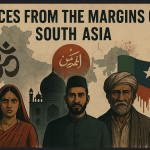
SADF NEWSLETTER: VOICES FROM THE MARGINS OF SOUTH ASIA
Image created by SADF’s Custom Chat GPT
INTRODUCTION: THE UNSEEN LIVES AMONG US
‘I’m not saying the people fighting them. I’m saying the civil population. Every single man, woman and child is not safe in Baluchistan. Every mother weeps when their child leaves the front door’
Mehran Marri, Baluchistan’s representative...
COMMENT 273 – Constitutional Recognition of Indigenous Peoples is Essential for Fostering Pluralism
Indigenous peoples are one of the ongoing topics of debate in Bangladesh. Since independence, the Chittagong Hill Tracts have been in turmoil due to the failure to include the ethnicity of indigenous peoples in the constitution formed in 1972. Although an agreement was signed in 1997, the main problems...